HI-TEK
Artist
Tony Shore
Medium
Acrylic on velvet
Dimensions
42 x 68
Tony Shore ’93 (Painting BFA) / Faculty, Painting Department

Tony Shore never really left Baltimore — or MICA. “I grew up here,” he says. “I went to the Baltimore School for the Arts, and by senior year, I was fortunate to get a scholarship to come to MICA.”
At the time, Baltimore wasn’t a recognized art-world capital. Yet Shore saw something enduring in its streets and row houses, the same way he saw promise in the college perched above Mount Royal Avenue. “There were other schools I looked at,” he remembers, “but I got a much larger scholarship here, and my teachers who had studied at MICA spoke so highly of it. Growing up, you knew the Baltimore Museum of Art, the Walters, and MICA. For me, art was my education; that’s what made me want to go to MICA.”
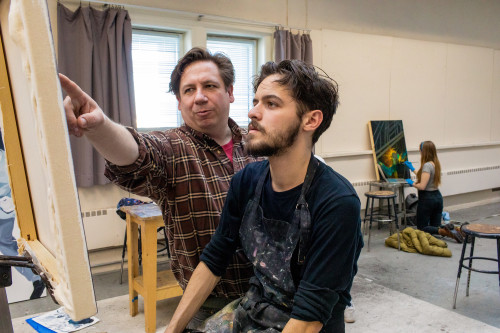
Shore arrived at MICA in the early 1990s with a sketchbook full of family scenes, neighborhood faces, and half-formed questions about where his art might lead. Three decades later, as a faculty member in the Painting Department, he still carries those questions, only now from the other side of the table.
Shore’s first years at MICA were a revelation. “Even though I still lived in Baltimore, the knowledge I was getting in my classes — ethnological art, sociology, painting — enabled me to step back from where I grew up and see it,” he says. “I started painting my family and my neighborhood. At first, it was kind of a joke. But the more time I spent, the more I realized I wanted to portray those people with honesty and dignity.”
That impulse — to turn the familiar into the profound — was encouraged by MICA faculty who refused to separate technique from truth. “One of my professors, Rex Stevens, became a longtime mentor. I was trying to figure out how graffiti, figurative painting, and ideas about my neighborhood could fit together. Rex said, ‘Why don’t you just do it?’ That permission changed everything.”
From that point on, Shore’s canvases — and later his luminous black-velvet paintings — became acts of reclamation. They captured the texture of Baltimore’s working-class life with a reverence that elevated everyday moments to epic scale. “As someone who was the first in my family to go to college,” he says, “I felt a responsibility to represent and to share those experiences.”
The same unpretentious honesty that anchors his work defines MICA itself. “Some schools are known for being ultra-experimental or super-traditional,” he says. “MICA sits in the sweet spot in between. We’ve always had that balance. Whatever kind of student you are, there’s somebody here who can meet you where you are.”


After earning his MFA at Yale, Shore came full circle in 2000 and returned to Baltimore. The homecoming was not only professional, but it was also personal. “When I was a kid, I went to the public library every day. The librarians would give me paper and pencils to draw. Years later, when the city closed that library, I got [city officials] to lease us the building for a dollar a year.”
That building became Access Art, a nonprofit community arts center Shore founded to give local kids the same creative refuge he’d once found. “MICA taught me to appreciate community, the importance of giving back to the place that shaped you,” he says. “I don’t think I’d have had that drive without MICA.”
As a painter and educator, Shore sees that same generosity reflected in his students. “When visiting artists come here, they’ll say, ‘The students were so nice; they held the door.’ It sounds simple, but it’s true. There’s a generosity that shows up not just in interactions, but in critiques.”
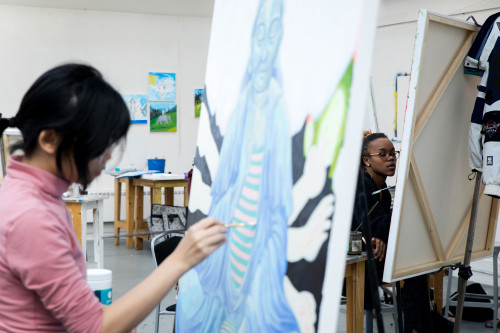
He describes MICA classrooms as “incubators.” One student experiments, another picks up the idea and takes it further. “Everyone learns on hyperdrive,” Shore says. “You’re not just learning from your own successes and failures, but from each other’s. That community energy is real. It’s what makes MICA different.”
That energy has tangible results. The AXA Prize for Figurative Art, a national award for undergraduate and graduate students, has been won three times in the past seven years by MICA painters. “That’s competing against 700 applicants from more than 100 schools,” Shore notes. “It tells you we’re doing something right.”
Now, as MICA approaches its 200th anniversary, Shore reflects on the institution’s staying power. “MICA has a deep appreciation for the fine arts,” he says. “As technology and AI develop, I hope students maintain that solid foundation. When the computers aren’t working, you should still be able to make something.”
He pauses, then adds, “Technology tends to replicate what’s been done. Art finds new ways to do things. That’s what creative problem-solving is about.”
For Shore, the legacy of MICA lies in the balance between innovation and tradition — the ability to look forward without forgetting where you started. “Whether it’s the statues in the main building that students are drawing from right now, or the teachers who’ve shaped generations, that history makes it possible to move into the future.”
That continuity is visible in his own life: a Baltimore kid who became a MICA student, then a department chair, now a faculty member in the department that first showed him art’s power to dignify the everyday. “I’m still learning from my students,” he says. “It’s reciprocal. I give to them, and I learn from them. That’s the cycle that keeps this place alive.”
As he reflects on 25 years at MICA and looks ahead to the school’s 200th anniversary, Shore recognizes his own journey as a mirror of its enduring spirit. “It’s the generosity,” he says simply. “The openness. The sense that everybody’s learning together.” Like his canvases, layered with light and shadow, MICA’s legacy is both intimate and immense — a portrait of creativity grounded in place yet unbound by it, rooted in Baltimore, fueled by imagination, and carried forward by community.

Join the festivities as MICA honors its 200-year history, recognizes its present success, and looks forward to a bright future. Throughout 2026, the College will be sharing community stories and announcing one-of-a-kind events on campus, in Baltimore, and beyond.