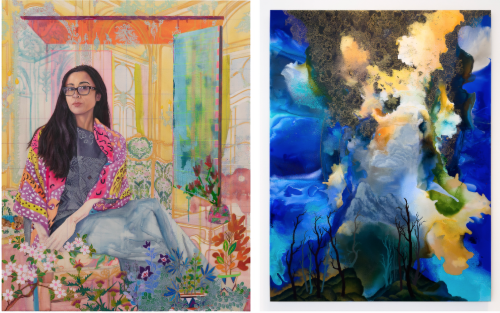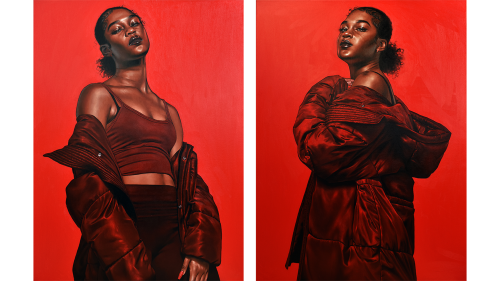
Maryland Institute College of Art Announces Exhibition Opening for Making America Again: So Strong, So Brave, So True
The exhibition runs August 28 to September 29, 2026, in the Sheila & Richard Riggs Gallery at MICA’s Fred Lazarus IV Center.
Phone Outage on Campus Affecting Incoming and Outgoing Phone Calls
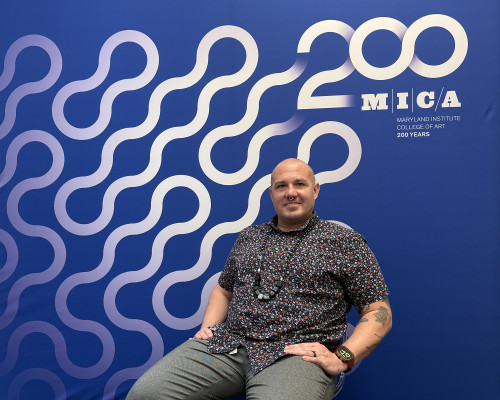
Martin Knuppel ’26 (Illustration & Printmaking BFA, Sequential Arts & Book Arts Minors)
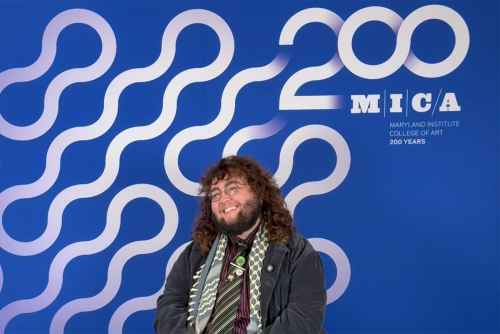
In the warm hum of MICA’s illustration studios, where the walls bloom with color, paper scraps, and pinned sketches, Martin Knuppel often settles into a rhythm that feels equal parts solitary and shared. A lightbox glows beside a stack of carved woodblocks; copper plates gleam on the desk; somewhere in the background, a friend cues up a playlist. “We’ll say, ‘I’m going into the studio,’ and then everybody comes,” Knuppel says, laughing. “We’ll work quietly for hours, take a snack break, talk, then go back to our projects. It keeps you focused but also connected.”
It’s that delicate balance — between independence and community, tradition and experimentation — that has shaped Knuppel’s time at MICA. As a dual major in illustration and printmaking with minors in sequential and book arts, Knuppel embodies the layered creativity that defines the MICA experience. “It’s kind of a hodgepodge of everything,” they admit with a grin. “But it rounds out in its own way.”
Growing up in Maryland, Knuppel didn’t have to look far to find MICA. It was, quite literally, in the neighborhood. “I’m a big Marylander,” they say. “When I decided I wanted to go to art school in middle school, I looked up art schools on the East Coast and found out that MICA was right here.” Their cousin had once dreamed of attending MICA too, planting an early seed of possibility.
By the time a MICA representative visited Knuppel’s high school, they were ready. “It just made sense. It was close to home, and I could still see my dog and visit my family. It felt right.”
Art had been Knuppel’s compass since elementary school, when a teacher praised their fifth-grade self-portrait. “Looking back, it was probably the ugliest thing ever,” they laugh, “but it was the first time I thought, ‘I can do something, and do it well.’” That sense of discovery persisted even through setbacks. Rejected from a middle-school gifted arts program, Knuppel kept drawing, eventually earning a spot in his school’s magnet art track. “They tried to hold me back in middle school,” Knuppel says with mock triumph. “But I made it through.”
Knuppel appreciates the freedom to build an artistic identity at MICA that defies boundaries. “I’ve been allowed to branch out into what I want to do,” they explain. “I knew in high school I wanted something printmaking-related, but I was also thinking about animation. At MICA, I’ve been able to do both.”
That cross-disciplinary encouragement runs deep in MICA’s DNA. For Knuppel, it’s not just about sampling multiple media; it’s about understanding how they inform one another. “When you mix colors digitally, it feels completely different from mixing an actual palette of oil-based inks,” they explain. “Printmaking teaches you to think about art in layers, the way each decision builds the final image. So now when I’m working on comics, it’s not just about what’s in a panel. It’s about how layers, color, and process work together across digital and traditional spaces.”
In this alchemy of old and new, MICA’s difference emerges: a culture that prizes both material mastery and conceptual range. It’s a place where artists learn to see — and to unsee — to take things apart so they can build something entirely their own.
That philosophy has carried into every corner of Knuppel’s practice, from the illustration studios to the Globe Collection and Press at MICA, where they now work as a print technician. “My boss, Allison, has shown me the ropes,” they say. “It’s taught me what it means to be a print tech, to be part of this larger ecosystem of printmaking that connects MICA to Baltimore’s history.”
It’s also shaped how Knuppel approaches community. Zine Fest, a student-run fair for self-publishing artists, has become a highlight of their year. “That’s honestly where I found the most community,” they say. Last year, Knuppel shared a booth with their friend, Goose. “We sold our art side by side, and my friend, Chris, was at the next table. It’s this all-day event where you’re surrounded by creativity. You have to make enough work to fill your wall, talk to people about it, sell it. It’s a monumental task, but it’s so rewarding.”
Knuppel sees its enduring strength in the character of its community of diversity, resilience, and heart. “I hope MICA continues to stand for its students and teachers,” they say. “There are so many here who are first-generation, or queer, or coming from places where college didn’t seem like an option. MICA has given them that chance.”
That inclusivity, Knuppel believes, isn’t just cultural, it’s creative. “The people here have backbones,” they say. “They take stands. They support each other. Being a student right now can be scary, but at MICA, people care. They make art that matters.”
It’s a vision that echoes the school’s founding spirit. Since 1826, MICA has balanced artistic innovation with civic purpose, a belief that art can both express and transform the world around it. For Knuppel, that mission continues every time they carve a block, ink a plate, or set up a booth at Zine Fest. “Being here has shown me there are so many ways to make a living doing what I love,” they say. “I don’t know exactly what the future holds, but I have the tools — and the confidence — to figure it out.
“I think that’s what makes MICA different,” Knuppel says. “You can be everything you want to be—and still find people who get it.”
Join the festivities as MICA honors its 200-year history, recognizes its present success, and looks forward to a bright future. Throughout 2026, the College will be sharing community stories and announcing one-of-a-kind events on campus, in Baltimore, and beyond.