First-Generation Journeys
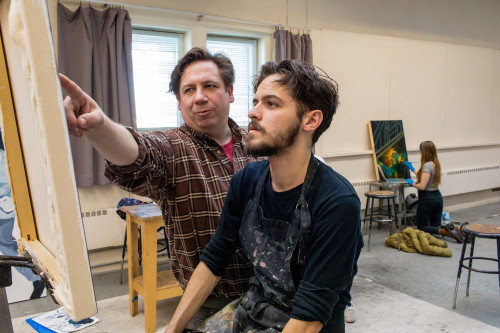
At MICA, first-generation college students have long brought their unique experiences, determination, and creativity to our community.
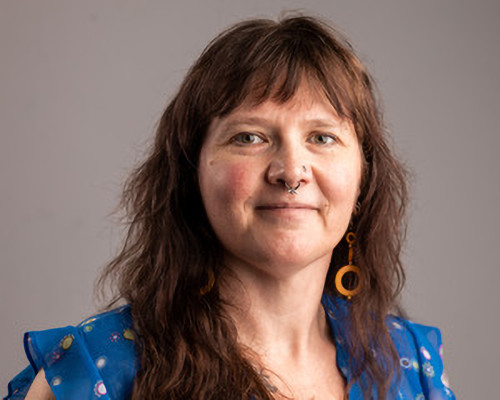
Dominique Samarco ’16 (Painting BFA)
When Dominique Samarco first walked onto MICA’s campus, she felt something click into place. The historic rowhouses glowed in the Baltimore sun, studios hummed with energy, and the whole place radiated an openness she hadn’t experienced anywhere else. “It felt like a true art school,” she remembers. “But it also had that beautiful campus feeling. There was life everywhere. I could tell it was a place where artists really grow.”
Getting there had taken grit. The daughter of a working-class family in Philadelphia, Samarco was the first in her family to go to college. She didn’t head straight to art school after high school. She enrolled at the Community College of Philadelphia, where a small but mighty art program changed everything. She found mentors who saw her potential and encouraged her to apply to four-year programs. “I worked really hard,” she says. “I was vice president of the honor society, and I poured everything into my portfolio.”
That portfolio earned her a scholarship to MICA, her dream school. “For someone in my family to go to college at all was a big deal,” she says. “Getting into MICA felt like a dream come true.”
One of her professors at the Community College, himself a MICA alum, organized a visit to Baltimore and introduced her to the then-chair of Painting. That trip sealed it. “When I saw the campus, I fell in love,” Samarco says. “It had this amazing energy, like everyone there was serious about art, but also about community.”
At MICA, Samarco found what she hadn’t realized she was missing: permission to fully explore her own ideas. “MICA allowed me to be 100 percent independent and follow my interests,” she says. “In a lot of education, you’re told what to do. At MICA, I was nurtured to experiment, to take risks, and not be afraid to fail. That freedom shaped everything.”
That sense of freedom, combined with a culture of mentorship and critique, helped her grow into the kind of artist who sees creative inquiry as a way of understanding the world. During her senior year, she began developing her own body of work, exploring how urban walls and surfaces carry stories about equity and community. “Looking back, I realize I was already doing research,” she says. “I just didn’t know that’s what it was at the time.”
For Samarco, MICA’s difference wasn’t just in its top-tier painting program; it was in how the school blended rigor with heart. “There was a spirit of curiosity and connection that ran through everything,” she says. “You could feel that the school valued both art and the people making it.”
After graduating in 2016, Samarco stayed in Baltimore for a short time and took a teaching position at a city school. The experience was transformative and sobering. “The art and music teachers were contracted because the schools didn’t have their own programs,” she says. “That really opened my eyes. Coming from a working-class background and then teaching in schools without arts programs, it hit me how unfair that was. Every student deserves the chance to express themselves and to learn independently through art.”
That realization pushed her toward education full-time. She went on to earn her Master of Education in Art Education at Tyler School of Art, grounding her creative instincts in pedagogy and policy. Today, she teaches AP Art and Design to 11th- and 12th-graders in the Philadelphia public school system.
Her classroom mirrors the structure she experienced at MICA: open, inquiry-based, and rooted in personal voice. “My students develop portfolios based on inquiry questions,” she explains. “We talk about research, creative voice, and concept development, not just technique. MICA taught me how to think critically and independently, and I try to pass that along. I help my students find their voices and pursue the ideas that matter to them.”
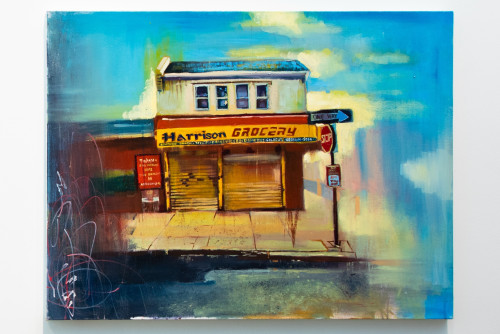
Samarco’s own artwork continues to reflect that approach. Her series, Philly Dreaming and Becoming, revisits spaces from her childhood through a lens of community and equity. The paintings are simultaneously dreamlike and gritty, echoing both the resilience and reinvention of her city. “It’s about identity, perseverance, and transformation,” she says. “Growing up in Philly taught me that the journey is long, but you keep going. I wanted my work to show that same endurance.”
Samarco’s story resonates with MICA’s founding vision: to make art education accessible, relevant, and transformative. Two centuries after what was originally known as the Maryland Institute for the Promotion of the Mechanic Arts first opened its doors to working citizens in Baltimore, MICA’s mission lives on in alumni like her.
“MICA gave me the foundation to help others find their voice,” she says. “It taught me that art isn’t just about making things; it’s about understanding who you are and how you connect to the world.”
In her classroom, she channels that lesson daily. Each student who walks through her door carries a story, a set of challenges, and a potential waiting to be unlocked. Samarco sees her role as helping them build confidence in their own creative process, just as her MICA mentors once did for her.
“Art changed my life,” she says simply. “And I want my students to know it can change theirs too.”
Join the festivities as MICA honors its 200-year history, recognizes its present success, and looks forward to a bright future. Throughout 2026, the College will be sharing community stories and announcing one-of-a-kind events on campus, in Baltimore, and beyond.