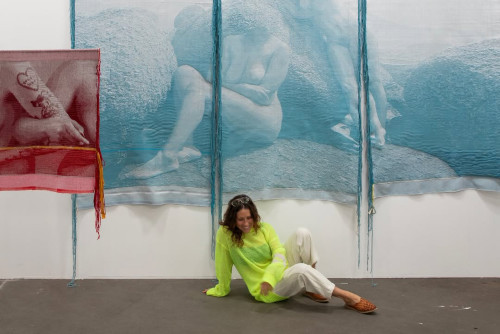
Mia Weiner starts with a photograph, often a body she’s choreographed into a pose that feels like a sentence without words. Then she does something that seems, at first, impossible: she dismantles the image into instructions. A map. A code. A set of intersections where every thread will lift or fall. The result is not a print and not a painting, but something older and more intimate: a woven surface where the image doesn’t sit on the cloth. It is the cloth.
That way of working — patient, rigorous, deeply attentive to both structure and sensation — didn’t emerge by accident for Weiner. It took shape early, long before international exhibitions or museum collections, when art itself still felt like an improbable future.
Weiner grew up in Evanston, Illinois, just outside Chicago, drawn instinctively to art but unsure it could ever become a career path or a life. Museums and images fascinated her, yet the idea of being an artist felt distant, almost unrealistic. It wasn’t until high school, through an introduction to conceptual art class and a formative experience, that the possibility crystallized. Art stopped being something Weiner admired and became something she could inhabit.
Finding Her Way
By the time she began looking at colleges, she knew she wanted a place that would take both material and meaning seriously. MICA stood out, not simply as a school with a rigorous fiber program, but as one that understood textiles as a contemporary language, capable of carrying questions of identity, gender, labor, and power. MICA wasn’t just where she learned to weave; it was where she learned how thinking, making, and feeling could be bound together, thread by thread.
A Way of Seeing
When Weiner describes what she learned from MICA, she doesn’t lead with equipment or technique, though both mattered. She leads with a way of seeing.
“MICA really helped me think about art differently,” she says. “Learn to talk about art. Be very conscious of the materials and different choices you’re making and why… really thinking about the artwork as a whole.”
That holistic attention — idea and object, reference and consequence — is one of MICA’s most enduring signatures, and where Weiner found a culture that did not treat textiles as decorative or secondary; it treated them as a field of inquiry. A place where softness could carry force. Where intimacy could be political. Where the body could be both subject and structure.
She also found studio critique as a practice of generosity. “I always liked critiques,” she says, and not in the dutiful way students sometimes say it. She means it. Critique, at its best, is an act of shared attention, many minds circling one object, offering interpretations the maker can’t access alone. “It’s this really amazing moment where you get eyes outside of your own,” she says. “There are all these things you haven’t thought of that people see.”
Then comes the part that feels especially MICA to Weiner: discernment. “It really helps you learn what to listen to and what is yours,” she says.
Pixel Becoming Thread
Today, Weiner’s work is both contemporary and ancient: a digital photograph translated into a handwoven tapestry, pixel becoming thread. It is a practice that responds to textile tradition while insisting on textile futurity.
She begins by photographing models, then edits the images digitally until the composition holds the emotional charge she’s chasing. “Once I feel ready,” she explains, “I break the image down into what we call a weaving draft… basically a map of where all the threads are going to go up and down.”
She works on a digital Jacquard loom (“basically a punch-card loom”), which becomes a bridge between centuries: the industrial logic of coded pattern meets the intimacy of touch. And then, crucially, she hand-weaves. That’s where the planning gives way to the body.
“As the work is hand-woven, intuitive movements enter,” she says. “Decisions are made in real time.” The process holds a balance of control and surrender, precision and responsiveness, mirroring a form of education that is structured enough to sustain focus, yet open enough to allow an artist to fully emerge.
Her subjects — bodies whose genders and faces are often concealed — invite viewers into a psychology of relationship rather than a narrative of identity. The works are intimate declarations: tenderness, secrecy, connection, vulnerability. In a moment marked by social and political division, her weavings refuse rigidity. They insist on softness as agency.
Reckoning and Becoming
Weaving, for her, is not a retreat from the digital world but a reckoning with it, where the image becomes an object. “We deal so much with the digital,” she says. “There’s this proliferation [of images]. But… through care and material labor — the hand — [you] make it physical again,” she says. “There’s something really amazing about turning the image back into an object, back into softness… that agency and powerfulness behind softness.”
This conceptual clarity of softness as power, labor as meaning, and intimacy as resistance has carried her Weiner beyond Baltimore. After earning her BFA in Fiber from MICA in 2013 and later an MFA from the School of the Art Institute of Chicago in 2020, she was named a Yaddo Fellow. Since then, her work has been exhibited internationally, including in New York, London, Los Angeles, Miami, Chicago, Rome, and the Netherlands. In 2024, she was awarded the V&A Parasol Prize by the Victoria & Albert Museum and the Parasol Foundation. Her work has appeared at Paris Photo and has entered the permanent collection of the Kunstmuseum Den Haag, The Netherlands.
If those milestones chart professional ascent, Weiner’s own measure of success sounds different. She talks about the moment a work leaves her hands and becomes something other people can inhabit, something that then exists outside her.
Asked what stays with her, Weiner returns not to process or recognition, but to encounter. The moment someone pauses, leans in, and finds themselves reflected — unexpectedly — in her work. That is enough. From there, the weaving has already done what it was meant to do.