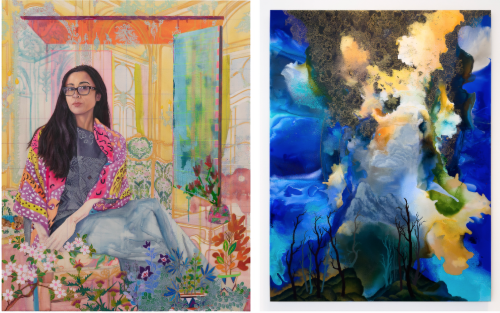
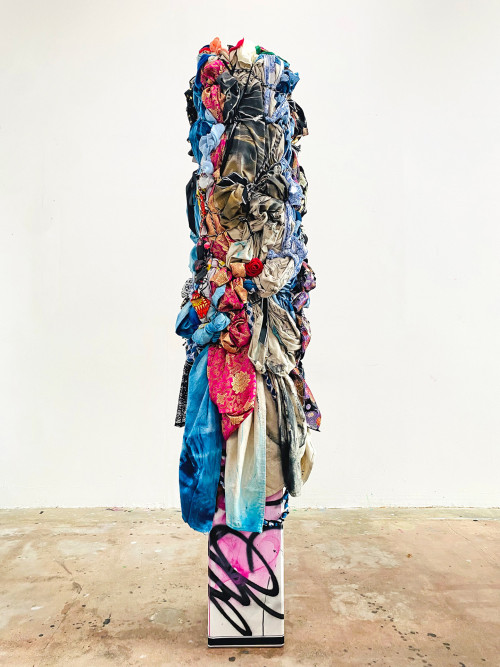
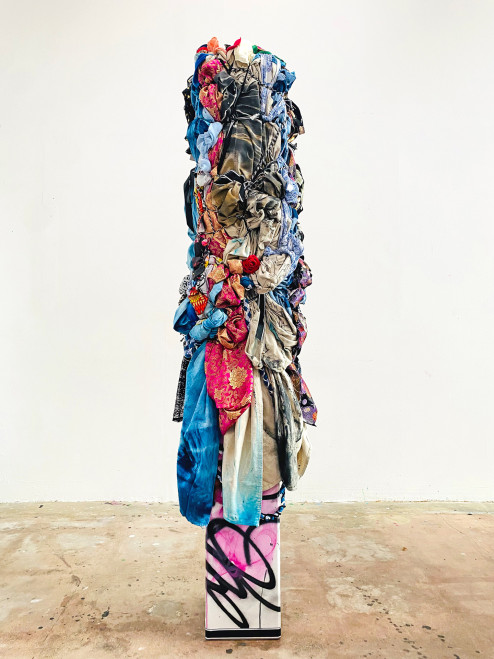
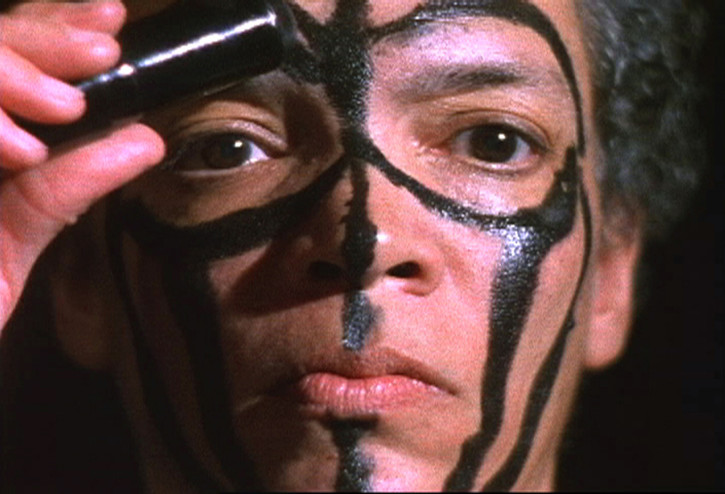
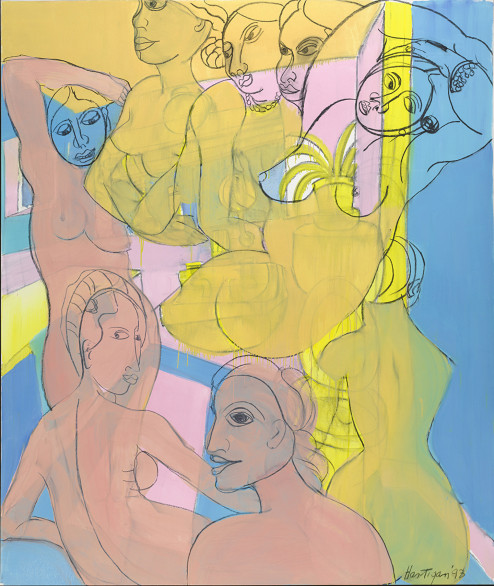
Bale Variant No 0027 (Charm City Girl Stele)
Artist
Shinique Smith ’92, ’03 (General Fine Arts BFA, Mount Royal School Of Art MFA)
Date
2022
ND Stevenson ’13 (Illustration BFA)
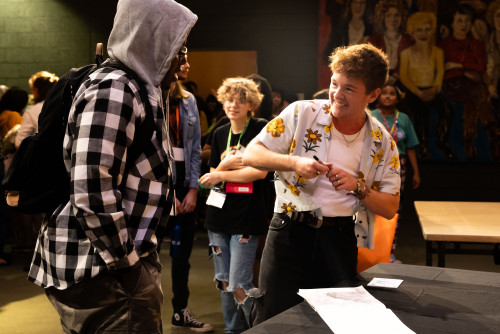
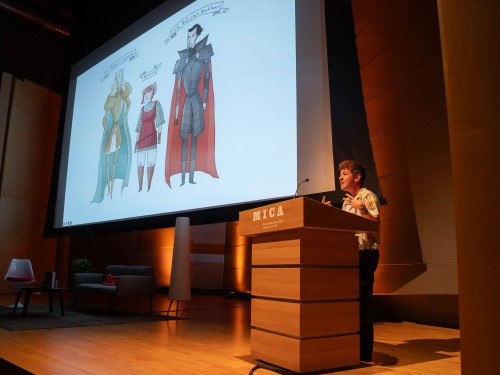
When ND “Nate” Stevenson talks about his time at MICA, he doesn’t dwell on accolades, though there are many. He’s the creator of Nimona, now an Academy Award-nominated animated feature, and the showrunner of Netflix’s She-Ra and the Princesses of Power. What he remembers most vividly is a classroom full of friends, laughter echoing through critique sessions, and the moment a teacher looked at his sketchbook and said, “Why aren’t you drawing like this?”
That, he says, was the first time he was told to draw like himself.
It’s a small but defining detail, one that captures the essence of MICA’s 200-year legacy. As the college celebrates its bicentennial, stories like Stevenson’s reveal what sets it apart: community as catalyst, curiosity as compass, and the enduring belief that art is a collective act of becoming.
Growing up in South Carolina, Stevenson didn’t know professional artists existed. Homeschooled until his junior year of high school, he learned from his parents and friends’ families, sketching stories and book scenes without realizing he was already illustrating narratives. When he finally entered public school, he found himself in a massive, underfunded system where art supplies were scarce and creative guidance even scarcer.
Then came the teacher who changed everything. She noticed his drive and made sure her student met representatives from art schools. One of them was from MICA.
“That was the first time I seriously considered going to school just for art,” Stevenson recalls. “I didn’t know anyone who’d done that.” Something about Baltimore — the city, the energy, even a teenage fondness for the production, Hairspray, felt right. The conversation that day turned possibility into intention. Scholarships would later make it real: the MICA Alumni Association Scholarship, the Neil H’17 & Sayra Meyerhoff Endowed Scholarship, and the Stuart B. Cooper ’72 Endowed Scholarship. They gave him more than funds; they gave him a foothold.
For Stevenson, MICA became the door to a world where art wasn’t just a hobby, but a language, and he was invited to speak it.
Stevenson arrived at MICA intending to illustrate children’s books. Writing, he thought, was “for other people.” Then a scheduling accident placed him in a comics class.
“I didn’t have a big connection to comics at that point,” he says. “I wasn’t particularly excited.” But something clicked almost immediately. Within weeks, the class became a tight-knit circle of about fifteen students who would form the core of his creative world. They were each other’s first audience, sharing jokes, pushing boundaries, and competing in the kind of way that made everyone better.
Even with a great teacher, Stevenson says, “We were always performing for each other, making art to make each other laugh or react.” That dynamic mirrored his earliest artistic memories: drawing stories to entertain his friends. Now it had an academic home.
The comics class wasn’t just a turning point for Stevenson; it was the birthplace of Nimona. A friend challenged him to create a two-page comic with original characters. Those two pages became ten, then more, until the story grew into his senior thesis and eventually a graphic novel that would win awards and become a global phenomenon.
It’s a quintessential MICA story: an experiment that turns into a career. A small classroom that launches a world.
While Nimona was taking shape, another story, Scarlet Morning, waited quietly in Stevenson’s sketchbooks. He had written its first draft as a teenager, a sprawling 600-page novel. At MICA, he kept revisiting its characters, trying to turn it into something visual. But the real lesson came when he realized that comics were not a diversion from writing; they were writing. “Comics tricked me back into [writing],” he says. “Even if no one sees the script, you still have to tell the story.”
That realization of voice and authorship became a through line in Stevenson’s creative life. He would go on to work professionally in both comics and animation, eventually returning to prose, conquering his fear of “putting words front and center.”
MICA, he says, was where he learned to be brave enough to do the thing that scared him most.
It was also where he learned to unlearn. “When you’re in college, out on your own for the first time, everything you think you know about yourself kind of explodes,” he reflects. Raised in a religious household, Stevenson arrived at MICA with clear boundaries and convictions. “Every single thing I thought I knew about myself, I had to rebuild.”
It wasn’t always easy, but it was transformative. “MICA was a place where I could do that work,” he says. Even when he felt adrift, he found community in classmates who were kind and patient, in a city that was “special and strange,” and in an art practice that allowed him to process the chaos through creativity. “It changed the trajectory of my life.
More than a decade after graduation, the echoes of MICA are still present in Stevenson’s studio and in the global creative teams he leads. When he became showrunner for She-Ra and the Princesses of Power, he found himself managing professional teams, guiding a vision that depended on collaboration. It was, in many ways, an extension of that first comics classroom.
“My time at MICA was defined by collaboration,” he says. “The moment your work comes back to you through someone else’s eyes, that’s when it becomes real.” Whether through an editor, an animation team, or his husband, his trusted first reader, Stevenson continues to build communities that function like MICA critiques: spaces where vulnerability and brilliance coexist.
Years later, when he returned to Baltimore for MICA Day, he found a campus both familiar and evolved. “It was strange being there well-rested and with no python,” he laughs, recalling a chaotic college apartment. But he also noticed a new culture emerging, one that values balance and sustainability. “There’s maybe been a little revolution in the arts,” he says. “People are starting to figure out that it’s OK to go to rest.”
Now based in Los Angeles, Stevenson’s community extends across mediums and continents. He describes it as a circle of artists who “look out for each other,” the kind of care he first experienced at MICA.
As MICA marks its 200th anniversary, Stevenson’s journey offers a microcosm of what the institution has stood for since 1826: risk, reinvention, and radical community. His story joins a chorus of alumni, faculty, and students whose creative lives answer the same question: “What makes MICA different?”
For Stevenson, the answer is simple and profound: “MICA is where I learned to draw like myself.”
It’s where a homeschooled kid from South Carolina could stumble into a comics class, find fifteen lifelong friends, invent a world-changing story, and discover that art is never made alone.



Join the festivities as MICA honors its 200-year history, recognizes its present success, and looks forward to a bright future. Throughout 2026, the College will be sharing community stories and announcing one-of-a-kind events on campus, in Baltimore, and beyond.