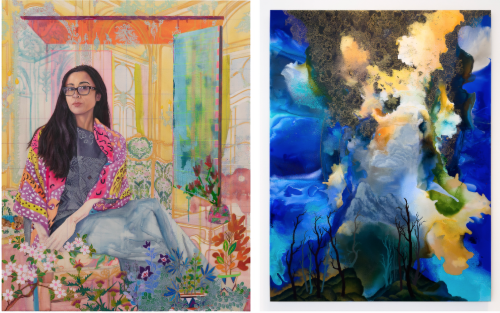
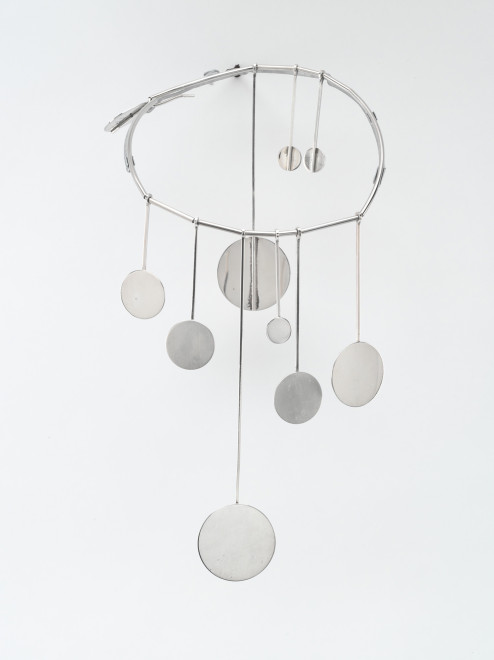
Bale Variant No 0027 (Charm City Girl Stele)
Artist
Shinique Smith ’92, ’03 (General Fine Arts BFA, Mount Royal School Of Art MFA)
Date
2022
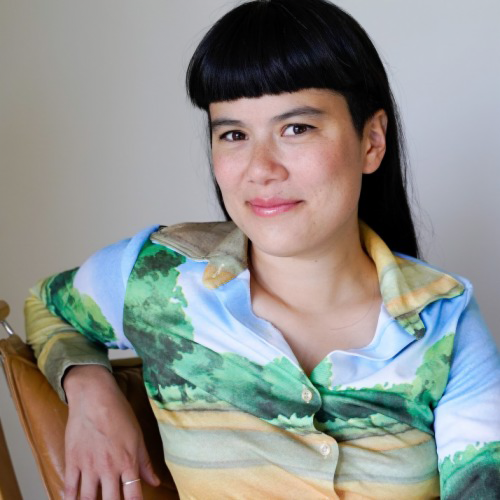
Amy Brusselback ’94 (Visual Communication Design BFA), Current MICA Board of Trustees member

At seven years old, Amy Brusselback printed business cards on scrap paper that read: “Amy Brusselback, Lawyer.” She cut them cleanly with child-sized scissors, handed them out like candy, and — tellingly— misspelled lawyer. The mistake feels charming now, but it was also a breadcrumb. Even then, Brusselback was composing, laying out type, producing a physical artifact that could travel from hand to hand. Long before she knew the language of grids and gutters, she was already using design to declare a possibility.
Brusselback grew up on a working farm that some might call a commune — hippies, carpenters, potters, people who made things with their hands and lived amid the objects they created. Still, she headed for the most linear of paths: Cornell, pre-law, a future planned in casebooks and clerkships.
The pivot came not with a thunderclap, but with a teacher who noticed patterns Brusselback couldn’t yet name. “You’re fine in your major,” the professor told her, “but you love your electives. You don’t have to follow the expected path.”
Soon, Brusselback was in New York City, an underpaid gopher at a design agency, typing for executives and absorbing more than any class could offer. She watched ideas move from strategy decks to comps to clients’ hands; she watched how visuals could answer practical questions faster than paragraphs could. “This is what I want to do,” she realized.
MICA entered the story first as a practical choice for Brusselback. In the late ’80s, art schools clustered in expensive cities. Baltimore was doable. But the decision turned out to be far more than logistics. What Brusselback found at MICA was an education grounded in fundamentals and animated by conversation, work that began with charcoal and composition and evolved into a lifelong habit of naming the why behind the beautiful.
“If I’d known more then, I would’ve chosen MICA even more intentionally,” she says.
Ask Brusselback what makes MICA different, and she names a pairing: Fine Arts + Liberal Arts, not as two checkboxes, but as a single habit of mind. The integration trained her to toggle between intuition and articulation, between “this feels right” and “here’s why it solves the problem.” That’s not rhetoric; it’s rigor.
She remembers her first art history exam: slides of paintings she’d never seen in the textbook. Identify the artist, then place the work in a political or social context. She failed. But the lesson was transformative. Art at MICA was not about recall; it was about relationship. What is the world around the work? How does the work change the world that surrounds it? The test was less a grade than a gateway, a realization that design thinking is connective thinking.
That connective discipline became the throughline of her career. “Artists make intuitive connections,” Brusselback says. “But in corporate spaces, you have to name those connections. MICA trained that balance.”
After graduating with a BFA in Visual Communication Design, Brusselback spent two decades leading brand transformations for global companies, including Procter & Gamble. Later, she founded a creative agency built around a premise she wished more agencies embraced: designers aren’t the last stop on a strategic train; they are co-authors of the journey.
That collaborative instinct traces back to MICA. The muscle she credits most to her time there is not a single software skill or stylistic signature; it’s critique, a structure that requires you to think, speak, and listen in equal measure. At MICA, critique wasn’t a once-a-semester spectacle; it was a daily practice of refining intention and impact. The result is not a thicker skin for its own sake, but a clearer voice and a more generous ear.
“I realized I was good at spotting the ‘nugget’ in someone else’s work, the spark that could make it a breakthrough,” Brusselback says. “Critique taught me to say ‘yes, and…’ instead of ‘no, but.’” When she built teams, she built them around that principle. No one brought a “finished” solution too early; the work began by framing the problem together, sketching possibilities in dialogue, keeping the user present at the table.
That approach challenges a common, well-meaning obstacle Brusselback noticed in the Midwest corporate culture where she spent many years: politeness. “Politeness can stifle innovation,” she says. “What MICA gave me was a culture of conversation. We could challenge each other’s thinking not to win, but to make the work better.” The result, time and again, was faster, higher-quality outcomes, solutions that felt “no-duh” only after the hard work of naming why they worked.
If you visit Brusselback today in Chicago, she’ll welcome you into “Amy’s Magical Lounge,” where in one corner stands her grandmother’s easel, built by her grandfather, a finance professional who made hundreds of birdhouses by hand. Posed on this easel, her grandmother painted artwork for decades but never called herself an artist; creativity was simply how their family lived.
The easel is more than an heirloom; it’s a thesis. Creativity is not a label you earn; it’s a way of seeing you practice. That belief is embedded in the Marion Brusselback Endowed Scholarship, which Brusselback established in her grandmother’s honor to help future MICA students thrive.
“Something so essential to our humanity shouldn’t be marginalized,” she says. “We are not here to produce starving artists. We are here to help creative people thrive.”
Brusselback hopes MICA continues to stand unapologetically for the centrality of art in human life, especially in an age of artificial intelligence and accelerated change. “Art brings humanity into the conversation,” she says. “It’s fundamental to feeling, to being alive.” The myth of the starving artist doesn’t hold up in a world that needs designers to help people navigate complexity with clarity and compassion. MICA’s charge, as she sees it, is to keep producing graduates who can do just that; people who pair imagination with articulation, beauty with purpose.
When Brusselback looks at the century ahead, she sees MICA as an anchor and an accelerant. The anchor is a commitment to fundamentals and to the dignity of making. The accelerant is a pedagogy that asks students to connect their work to the world and to speak about those connections with clarity.

Join the festivities as MICA honors its 200-year history, recognizes its present success, and looks forward to a bright future. Throughout 2026, the College will be sharing community stories and announcing one-of-a-kind events on campus, in Baltimore, and beyond.