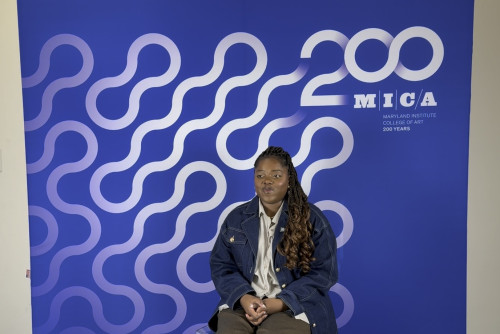
When Elielle Kayomb first visited MICA’s campus — when considering art school after two years at a Maryland community college — she assumed she already knew Baltimore. Her earliest memory of the city was a postcard-perfect image: National Harbor, glittering buildings, water, sunshine — a polished introduction to a place she assumed she understood. But like so many artists who arrive at MICA, she would discover a very different Baltimore, and in turn, a very different version of herself.
What she didn’t know then was that MICA would become not just the place she learned to paint, but the place that would catch her during the hardest season of her life, challenge her to make art that mattered, and ultimately shape the teacher, artist, and healer she is becoming.
A Long Way from Home
Born in Congo, raised in South Africa, and later joining family in the United States, Kayomb learned early that identity is layered, something to be re-assembled again and again as language, landscape, and belonging shift. Art, even before it was her declared major, gave her a way to stitch the pieces together.
But becoming an artist wasn’t always an accepted option.
“When I started at [the community college], I told my family I was studying business,” she says. “But really, I wanted to take a painting class.”
She walked into the art department, portfolio in hand, hoping to at least audit a course without the prerequisites. Instead, the faculty asked her one question: “Why aren’t you already in the program?” Within weeks, she was.
That decision would set the course for everything that followed. At the end of her two years there, she attended a portfolio night and met representatives from several schools. One school, she knew. Other art schools, she researched. One had a name she didn’t recognize: MICA. But something shifted after her campus visit in Baltimore. “I saw the student work and thought, ‘This is the level I want to reach.’ I didn’t feel intimidated. I felt invited,” she recalls.
Her credits transferred, her acceptance letter arrived, and she chose MICA not because it was out of reach, but because it felt like home, even before she knew why.
Showing Up
Many students come to MICA expecting what they’ve been told to expect from college: anonymity, large classes, and a sense of being processed more than seen.
Kayomb found the opposite.
“One of the biggest things I’ve experienced here is kindness,” she says, without hesitation. “Not just academic support, but real care.”
Her first semester should have been defined by excitement: new campus, new studios, new peers. Instead, she was diagnosed with a chronic illness the week before classes started, and halfway through the semester, her brother passed away.
“That could have been the end of college for me,” she says. “There were days I didn’t think I would finish the semester, let alone the degree.”
Instead of falling through institutional cracks, she was surrounded.
Faculty didn’t just adjust deadlines; they showed up in hospitals, in email inboxes, in studio visits. Several of her professors didn’t just critique her work; they helped her stay alive inside of it.
“People say, ‘In college, you’re just a number.’ That has never been true here. I don’t think I would’ve made it through without the way people cared, and I don’t think I’m the only one with that story.”
Yes, the curriculum sharpened her technique. Yes, the critiques challenged her ideas. Yes, the visiting artists expanded her worldview. But the thing that changed her life was the culture, a daily, quiet ethic of grace.
“What makes MICA different,” Kayomb says, “is that growth here includes the human being, not just the artist.”
Beyond the Paintbrush
When Kayomb arrived, she was creating portraits. By junior year, her work had shifted into something deeper: paintings in dialogue with memory, grief, cultural displacement, and belonging. She began asking not just “How do I paint this?” but “Why am I painting this? Who is this for? What truth does this hold?”
That shift came not from technique alone, but from conversations in critiques where students learned from one another, in artist talks where working professionals told the truth about failure, and in private studio visits where professors offered not answers, but questions.
“The critiques weren’t attacks; they were conversations. You learn how to decide what feedback shapes you and what feedback you release. That’s not just an art lesson. That’s a life lesson.”
And as her artistic voice sharpened, something else surfaced: the desire to teach.
Coming Full Circle
School, she says, was always her first refuge. At ten years old in South Africa, she found herself in a new country, learning a new language, and adapting to a new lifestyle. It was teachers who made room for her to belong. Now, with a BFA in hand and a master’s on the horizon, she hopes to return that gift.
“I want to be a working artist and a teacher. I want both,” she says. “Teaching is how I honor the people who carried me. It’s how I give that back.”
Her vision for the future isn’t glamorous, but it is grounded: a light-filled classroom, a studio that doubles as a laboratory of memory and imagination, where students learn that art is not born from perfection, but from lived experience.
In that future, she can imagine herself clearly: in a classroom, brush in one hand and lesson plan in the other, helping the next generation of artists recognize that their stories are not obstacles to art — they are the art.
For Kayomb, MICA was not the place she expected. It was something stranger, harder, and far more generous: the place that held her long enough for her to become whole, and the place that pointed her toward a life where she might do the same for others.