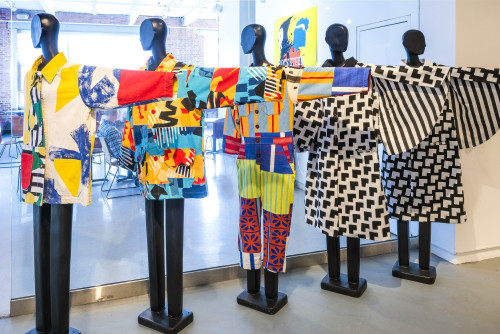
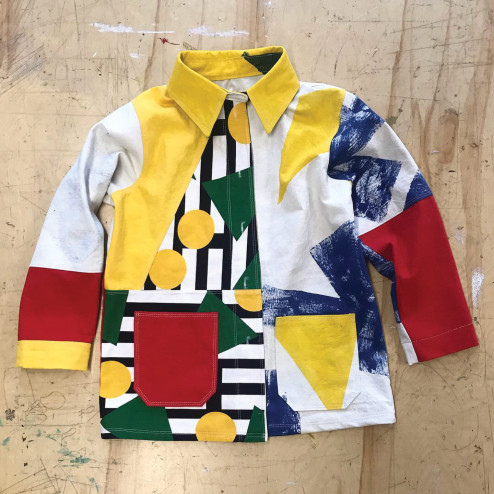
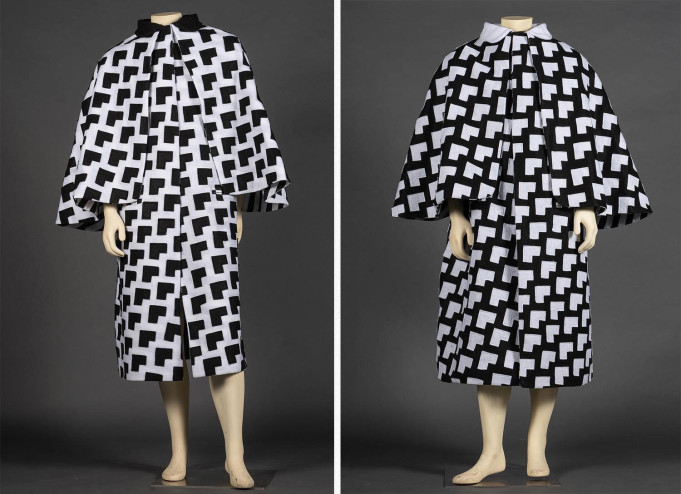
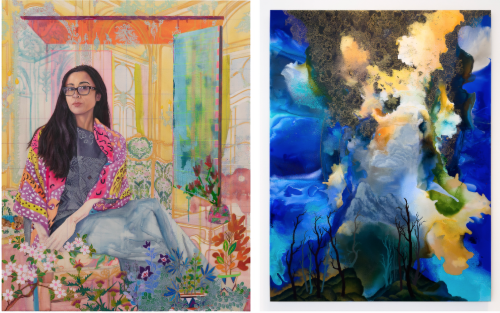
In kindergarten, William “Will” Grimm remembers watching their grandmother hem a pair of thrift-store pants at the kitchen table in Pittsburgh. Money was tight. Clothes were hand-me-downs, often ill-fitting, sometimes stained. Their grandmother’s needle moved in and out of the fabric with quiet precision, transforming something discarded into something wearable.
“I was so bewitched just by watching her take the needle and thread,” Grimm recalls. “Now when I talk about it, I think about the metaphysics of it; she was taking a line and using that to join two planes. That’s sort of the magic I see in it now.”
As a child, he didn’t have that language. He just knew it felt powerful.
Soon after, their grandmother took him to a craft store, where they picked out a bundle of fat quarters and began sewing pillows for their thrifted Cabbage Patch dolls. He punched holes into construction paper and wove yarn through them to make makeshift blankets. Textiles were not simply materials; they were portals into care, protection, and imagination.
“I think I was always drawn to the sense of safety they create,” Grimm says. “We wear them for protection. We use them for warmth. They shelter us. I’ve always gravitated toward that.”
Today, that childhood fascination has evolved into a nationally recognized fiber practice rooted in memory, identity, and lived experience. But at its core, their work still returns to that first spell cast at the kitchen table: thread joining planes, fabric holding feeling.
Textiles as Diary
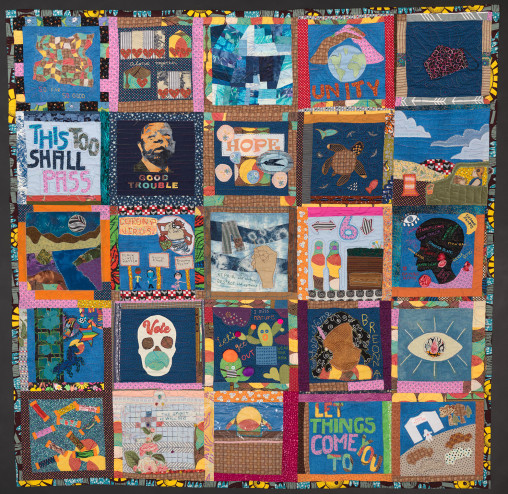
Grimm often describes their pieces as “diary entries.” The phrase is not metaphorical flourish; it is a working method.
“When I make something, it’s coming out of a backlog,” he explains. “I’ll ruminate and think about what I’m going to make for three or four months. Then one day I get the urge, and I start. Letting it stew for so long allows me to work improvisationally.”
In the studio, he approaches their materials almost conversationally. The result is a practice guided as much by intuition as by intention, an improvisational choreography shaped by months of internal planning. Handling cloth becomes a form of thinking. The repetitive gestures, quiet the noise of the outside world. “It’s a space where I can really be with myself and my thoughts,” Grimm says. “A lot of my work ends up being a brain dump of where I’m at.”
For a period during the pandemic, that “where I’m at” was Cleveland’s landscape. Laid off from their job and adhering closely to stay-at-home orders, Grimm walked daily through their neighborhood. The changing sky, the quiet streets, the textures of place seeped into their compositions. More recently, they have begun integrating an interest in graphic design, an influence sharpened by a graduate seminar in the history of modern graphic design.
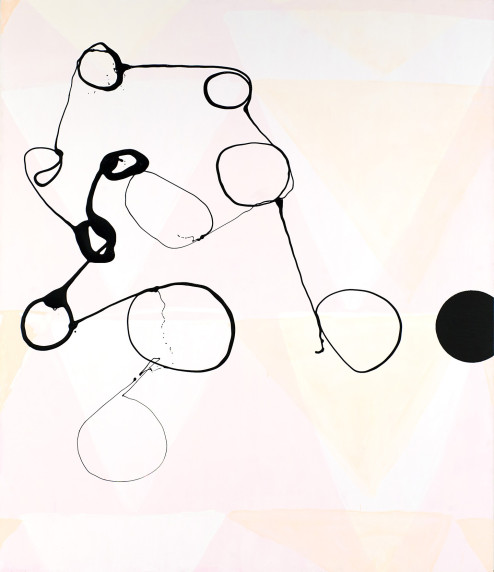
“I think I’m heavily influenced by the internet, by media, by consumer culture,” he says. “And that ties back into textile waste and overconsumption.” Typography, fragmented language, and graphic motifs have begun to surface in their thesis work, signaling an evolution that remains firmly tethered to cloth.
Working with What’s Left Behind
Currently in graduate school, Grimm’s material practice shifted significantly. As an undergraduate at MICA, they were deeply invested in the entire textile lifecycle — spinning yarn, weaving cloth, quilting the finished fabric. The labor was deliberate and immersive. But graduate school demanded speed and iteration.
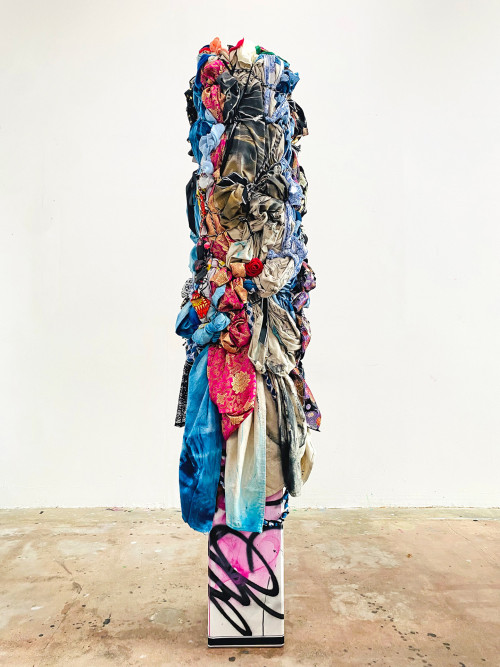
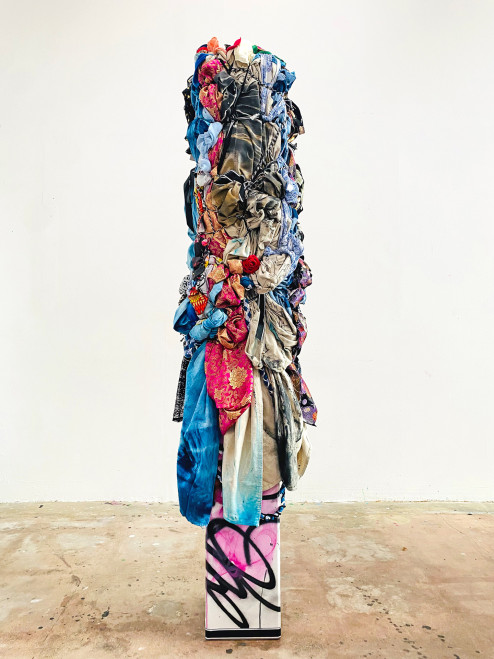
More importantly, he began to question the necessity of producing new material in a world overflowing with excess. “There’s so much waste. Most of this came from the street,” they say, gesturing to their studio. “I don’t need to spend all my labor producing new material.”
Now, Grimm works almost exclusively with recycled textiles, found fabrics scavenged from their neighborhood or sourced from castoffs. The constraint has become generative. Each new piece is a puzzle defined by what is available, a negotiation between intention and limitation. The practice reflects not only environmental awareness but also a philosophical stance: that textiles carry histories, that reuse is both ethical and poetic.
A Legendary Department — and a Home
Grimm knew they wanted to major in fiber before they set foot on MICA’s campus. Pittsburgh’s magnet arts high school had introduced them to the possibility of a career in textiles. Once they realized that artists could build lives around fiber, “it was game over.”
MICA’s fiber department — large, faculty-rich, and widely respected — felt like the place to grow. “It was huge when I was there,” he recalls. “More full-time faculty than I’ve encountered anywhere else.”
But what stands out most in retrospect is not scale but spirit. During the height of the pandemic, isolated and uncertain, Grimm found themselves yearning not just for Baltimore, but specifically for the fiber department. “I remember feeling so lonely one day and thinking, I just want to go home. I want to see my people,” he says. “That’s where I want to be.”
MICA faculty members shaped their education in ways that extended far beyond technique. “They knew what a student needed and when,” Grimm says. “They were accepting of everything, very open to whatever you wanted to work on, but they also pushed you.”
That balance of freedom and rigor allowed Grimm to explore their identity and voice without being molded into someone else’s aesthetic. “I felt such a freedom to be who I needed to be,” he says.
They credit MICA not only with sharpening their craft but with teaching them how to think creatively. “I learned creative problem-solving,” they reflect. “You can take that anywhere. I feel like those four years gave my brain a workout on how to stay weird, in a good way.”