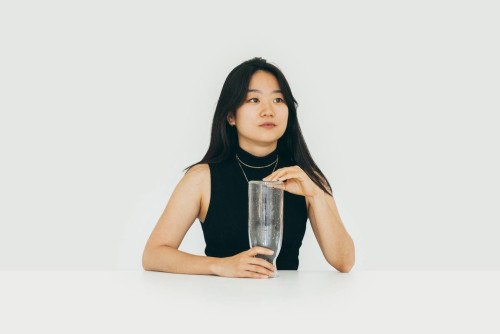
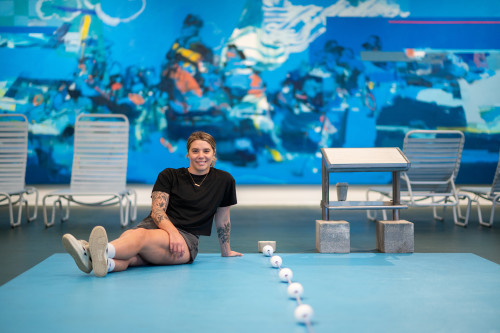
When Kurina Sohn begins tracing the geography of her life, the conversation naturally stretches between continents, disciplines, and ways of knowing. Born in Korea, raised across the United States and Asia, educated in Baltimore and Italy, and now living and teaching in the Netherlands, Sohn’s life and work resist easy categorization. Yet when she speaks about her years at MICA, one thing becomes clear: MICA was not simply a stop along the way. It was formative infrastructure, a place where curiosity was encouraged, craft was taken seriously, and interdisciplinary thinking became second nature.
Finding A Way Through Fiber
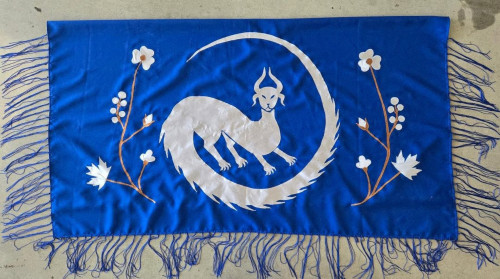
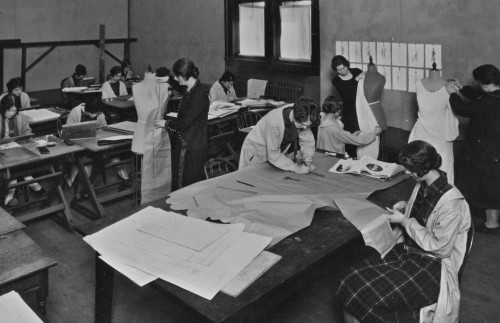
Although, Sohn enrolled as a graphic design major, it was the fiber department that pulled her in. She was drawn to its tactile nature, to the insistence on material knowledge, and to a culture that valued learning how to do things properly.
“It wasn’t about rushing or just watching a YouTube video,” she recalls. “We learned dyeing, pattern-making, and printing. There was an emphasis on understanding the process deeply.”
That grounding in craft, often underestimated in conversations about contemporary art and technology, became the backbone of a practice that would later span digital fabrication, AI-generated imagery, and immersive environments.
Thinking Across Dimensions
Fiber, for Sohn, was never only about textiles; it was a way of thinking. Pattern-making taught her how to move between dimensions: how something conceived in two dimensions becomes three-dimensional when it lives on a body. That conceptual shift between flatness and volume, plan and experience continues to inform her work today. Whether she is building garments, constructing digital forms, or collaborating on CGI environments, the logic is the same. “That crossover between dimensions translates really well to digital work,” she says. “It’s still about structure, transformation, and how something comes into being.”
Collaboration as Catalyst
One of the most influential experiences of her undergraduate years came through an International Collaboration course. The class united artists, coders, and institutions across borders, including a partnership with the Willem de Kooning Academy in the Netherlands. A visiting coder, who at the time worked at NASA, expanded the class’s sense of what collaboration could look like. For Sohn, the course was a revelation. It was also her first introduction to the Netherlands, where she would later build much of her professional life.
That experience did more than broaden her résumé; it reshaped her understanding of what it meant to be an artist. Sohn interned and later became an assistant, gaining insight not only into teaching but into the lived reality of artistic practice.
“I learned about being an artist as a human being,” she says, “not as some untouchable figure.”
That lesson mattered. Today, as she teaches at the bachelor’s level in the Netherlands, Sohn often finds herself reflecting on the education she received at MICA, where graduate school offered depth and specialization, and MICA offered freedom: a strong foundation paired with permission to roam.
That freedom is something Sohn recognizes more clearly now that she stands on the other side of the classroom. MICA’s studio culture, she notes, allowed students to move across departments without being policed by disciplinary boundaries. The result was an environment where interdisciplinary work felt natural rather than exceptional. That ethos made it easier for her to bridge art and technology, not as a novelty, but as a necessity.
Curiosity at the Edge of the Known
Sohn’s current practice is driven by research and curiosity. She describes herself as someone who gets bored easily, drawn to things she doesn’t fully understand. That restlessness fuels projects that sit at the edges of knowledge and perception. One long-term work, Deepest Unknown, explored how artificial intelligence might “experience” the deep sea. Unlike humans, who rely on sensory perception, AI understands the world through the data it is given — images, text, numbers. What happens, Sohn wondered, when those two modes of knowing collide?
The project unfolded in phases and through collaboration. Sohn worked with a sound engineer to create an immersive soundscape and with a full CGI team to produce a 360-degree deep-sea film. In a later phase, she layered AI-filtered imagery, AI-generated creatures, and AI-written text. Multiple AI systems were used at a time when video-generating tools were not yet widely available. The work required not only technical ingenuity but artistic intuition: a sense of pacing, atmosphere, and meaning that could not be automated.
That balance between concept and execution, research and making has been a throughline since her MICA days. The International Collaboration course taught her how to articulate a vision even when she didn’t yet know how to realize it. It made her comfortable working with people outside her field and asking for expertise she didn’t possess.
“Often I knew what I wanted to make,” she says, “but I needed a way to get there.” At MICA, that gap was not a failure. It was an invitation.
Today, Sohn continues to freelance alongside her teaching practice, supporting her day-to-day life while developing ambitious new work. In March 2026, she will open her first solo exhibition, a milestone that is both exhilarating and daunting.
Portrait of an Artist
In the context of MICA’s 200th anniversary, Sohn’s story offers a compelling portrait of what a MICA education can make possible. It is not a straight line from major to job title, nor a tidy narrative of success. Instead, it is a web of experiences — studio courses, international collaborations, mentorship, craft traditions — that continue to reverberate across decades and continents. MICA did not give Sohn a single answer to what art should be. It gave her the tools, confidence, and curiosity to keep asking.