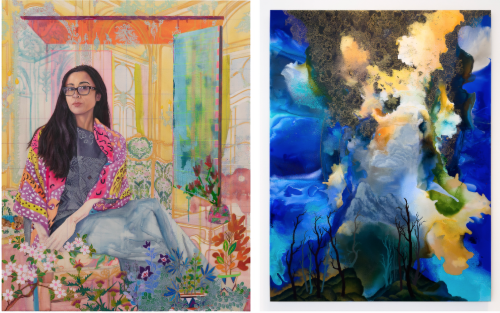
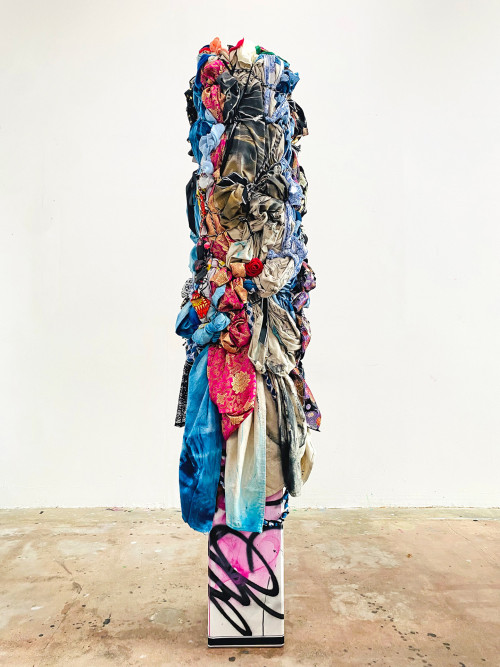
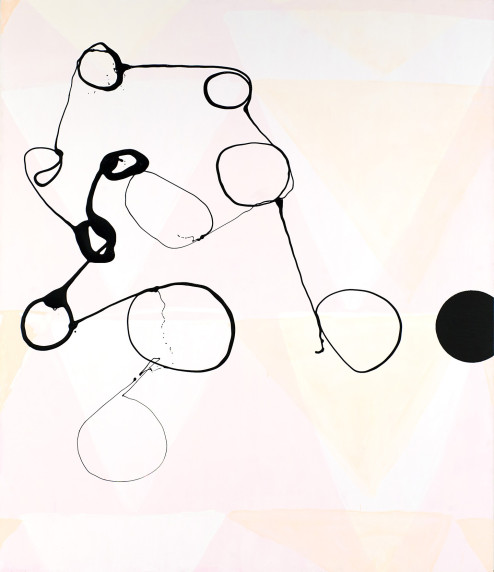
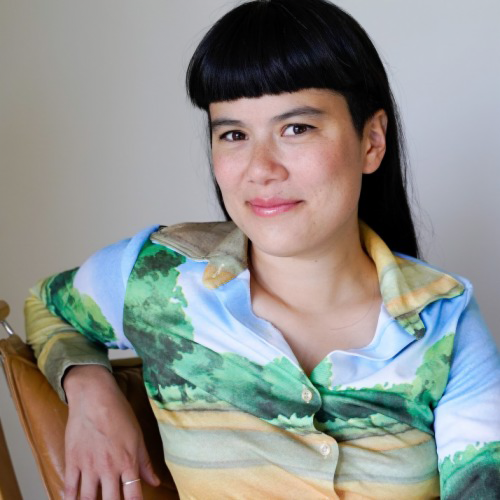
Bale Variant No 0027 (Charm City Girl Stele)
Artist
Shinique Smith ’92, ’03 (General Fine Arts BFA, Mount Royal School Of Art MFA)
Date
2022
Carolyn Campbell ’72 (Interior Design BFA)
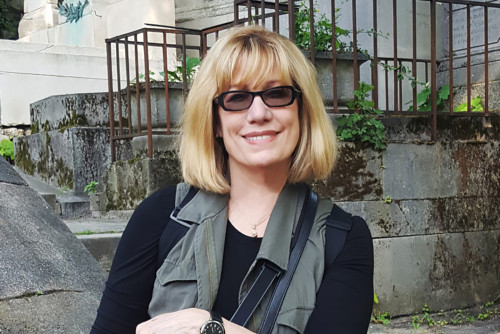
When Carolyn Campbell describes her years at MICA, she still calls it “the Institute.” The name itself carries the aura of a time when Baltimore’s art scene pulsed with the raw, experimental energy of the late 1960s.
A Washington, D.C., native, Campbell arrived at MICA in 1967 — young, curious, and ready to trade convent-school discipline for something freer, riskier, and more alive. And for a girl raised in the nation’s capital, Baltimore felt like another world: “The tuition was affordable, the people were creative and eccentric, and the city itself was an education. The main building’s architecture reminded me of grand D.C. institutions, but what happened inside was completely different.”
It was the late 1960s, a period when art, politics, and culture were colliding. “I was suddenly surrounded by painters, sculptors, writers, and filmmakers who were living and breathing their work,” Campbell recalls.
Campbell insists that MICA’s magic lies in its sense of intimacy, of how an urban campus manages to feel like a village of creative souls. “Baltimore is a big city that feels small,” she says. “Everyone’s connected — artists, musicians, poets. You can’t separate the arts from the city’s heartbeat.”
She recalls meeting the actor, singer, and drag queen, Divine, in the Mount Royal cafeteria, an encounter that led to a cameo in John Waters’ Polyester. “Those 15 seconds of fame were so very Baltimore,” she jokes. “It was fearless, weird, and joyful all at once. That’s what MICA was.”
More than the eccentric characters, though, Campbell remembers the deep sense of care that underpinned the school. “Administrators worked with students through all sorts of personal and creative crises; they were our rock. They modeled compassion in the midst of chaos,” she says. “That balance of intensity and humanity — that’s MICA.”
That environment stood in stark contrast, she says, to the transactional landscape she would encounter in Los Angeles. “Here, everything is sprawling. At MICA, everyone was part of something larger than themselves, and that’s what made it so transformative.”
After graduating summa cum laude in 1972, Campbell took MICA’s lessons of courage and collaboration into the professional world. She became the first PR and Special Events Director at the Corcoran Gallery of Art in Washington, D.C., where she discovered how to translate “curatorial speak” into language that invited people in.
“MICA taught me that art opens lives,” she says. “At the Corcoran, I realized my job was to help more people feel that sense of wonder, to take art out of its ivory tower and make it accessible.”
That commitment followed her west when she relocated to Los Angeles. After a brief stint in the nonprofit world, she founded her own arts communications firm at a time when few others were doing so. “I didn’t have a business degree,” she says. “But I had passion, and that was enough.”
Campbell’s career has been defined by her willingness to say “yes” to new ideas, new media, and new artists. She’s promoted museums, galleries, and architects; coached artists on how to tell their stories; and even accepted artwork as payment when clients couldn’t afford her fees. “My studio walls are covered with pieces from people I’ve worked with,” she says proudly. “Every one of them reminds me that creativity is a kind of currency.”
Her generosity extends beyond professional mentorship. More than a decade ago, Campbell established the Billy N. Hadaway ’51 and Sonia Gordon Memorial Scholarship at MICA to honor her late friend and mentor, jeweler Billy Hadaway. “Billy was extraordinary,” she recalls. “He was funny, opinionated, brilliant, and authentic.”
Hadaway’s mentorship helped Campbell find confidence in her own artistic instincts. “He could be a tough critic, but he always made me see the value of the work. He represented what it means to live as a creative spirit fully, unapologetically.”
Her scholarship keeps that spirit alive, supporting students across disciplines who embody that same fearless curiosity. “It’s not a huge amount of money,” she says modestly, “but it’s something that can make a difference at the right moment.”
If the arc of Campbell’s career has one constant, it’s storytelling. Her most recent chapter — literally — grew from her lifelong fascination with history, memory, and art. In 2019, she published City of Immortals: Père-Lachaise Cemetery, Paris, a book exploring the famous artists and writers buried there, from Oscar Wilde and Amedeo Modigliani to Édith Piaf. The book became a bestseller and is now entering its third printing, with a documentary film in development.
“Writing the book and photographing that cemetery felt like everything had come full circle,” she says. “It was about honoring creative legacies, exactly what MICA has always done.”
Now based in West Hollywood, Campbell continues to mentor artists, lead workshops, and advocate for the arts. She still draws on the lessons she learned in Baltimore more than fifty years ago: “MICA gave me the courage to live a creative life on my own terms.”
She advises students not to be discouraged, to have a plan, and not to feel ashamed of their side job to do what they need to sustain their creativity. Campbell hopes MICA continues to nurture that blend of rigor and risk that defined her own student years. “At MICA, we weren’t just making art; we were learning how to see differently, how to live differently. MICA made me fearless,” she says. “It showed me that creativity isn’t something you do; it’s who you are.”
That conviction — bold, joyful, and generous — is what she hopes will carry MICA into its next 200 years.
Join the festivities as MICA honors its 200-year history, recognizes its present success, and looks forward to a bright future. Throughout 2026, the College will be sharing community stories and announcing one-of-a-kind events on campus, in Baltimore, and beyond.