First-Generation Journeys
At MICA, first-generation college students have long brought their unique experiences, determination, and creativity to our community.
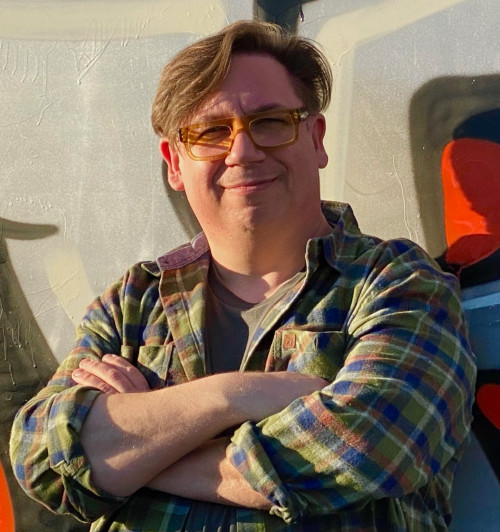
Artie Sadahiro ’26, Student (Ecosystems, Sustainability, and Justice BFA, Printmaking Minor, Painting Minor)
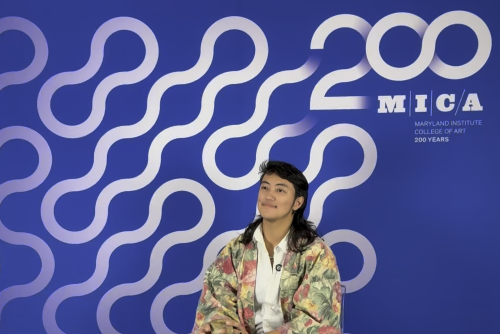
On a misty Seattle morning, long before most of his classmates were awake, Artie Sadahiro stood first in line outside the National Portfolio Day venue at his school, arms straining under the weight of a rain-spotted portfolio case. “It was 9:30 a.m. and pouring,” he remembers with a laugh. “I was so nervous.”
But that morning changed everything when he met a MICA admissions counselor who didn’t just glance through his work. “He really talked with me,” Sadahiro says. “It wasn’t about selling me on MICA. It was about who I was as an artist, who I could become.”
That conversation revealed something essential to Sadahiro: the MICA community’s commitment to seeing students not as applicants but as artists already in motion. “That was my first experience of how strong and personal the MICA community is,” Sadahiro says. “From that moment, I felt like I belonged.”
When he finally visited Baltimore, the feeling deepened. “I saw how interdisciplinary the campus was, students painting in the hallway, printmakers collaborating with animators, people creating things I didn’t even have words for yet,” he recalls. And in a serendipitous twist, he discovered that Baltimore had a rowing club. “I’ve rowed competitively for nearly ten years. I thought going to art school meant I’d have to give that up. But then I found out there was a club nearby. It felt like a sign.”
That blend of passion and possibility—of art meeting life—became the first thread in Sadahiro’s MICA story.
When Sadahiro arrived at MICA, he planned to major in illustration. “It felt safe,” he says. “I knew I could draw, and it seemed like the logical path.”
But the more he explored, the more his interests began to stretch beyond a single medium. Painting led to printmaking, and both eventually pointed him toward a small but growing program, he’d been quietly curious about: Ecosystems, Sustainability, and Justice (ESJ).
“At first, I was intimidated; it sounded really STEM-heavy,” he says. “I’ve always been more analog. Coming from Seattle, where tech is everywhere, I had to unlearn what ‘science’ could mean.”
At MICA, he discovered that science, art, and activism could coexist. “One student might be creating sound installations about water access. Another might use collage to talk about urban farming. Everyone’s working toward climate justice, just in different creative languages.”
The ESJ program’s small size—only a handful of seniors—has made it a tight-knit community. “You know everyone’s practice,” Sadahiro says. “You’re constantly learning from each other. There’s this sense of building something new together.”
That intimacy mirrors what Sadahiro sees across MICA: the way big ideas thrive inside small, passionate communities. “It’s not a place where people compete to be the best,” he says. “It’s where people push each other to go deeper. MICA feels alive because everyone’s in dialogue.”
Sadahiro’s MICA journey came not only in a classroom but on the streets, where biking has become central to how he experiences Baltimore. “When you bike, you see the city differently. You notice how it’s designed. You see the gaps, the communities, the rhythm.”
He’s also found belonging in Baltimore’s cycling community, through monthly Baltimore Bike Party rides and advocacy work with groups like Bikemore. “It’s activism through joy,” he says. “You show up, you move, and suddenly you’re part of something bigger.”
That same spirit of connection infuses his rowing life, too. Sadahiro has had the opportunity to compete at regattas across the East Coast. Most notably at Head of the Charles, the world's largest 3 day regatta, with Rowing in Color, a nonprofit that connects rowers of color from across the country. “It’s about representation, but also about building community,” he says. “It reminds me of MICA, the idea that creativity and belonging go hand in hand.”
Sadahiro’s creative practice deepened further through a public-art project led by Baltimore artist and MICA professor Ernest Shaw.
“On the first day, Professor Shaw took us up to the second floor of Main and told us to look across the atrium at an existing mural,” Sadahiro recalls. “‘What do these symbols mean?’ he asked. ‘Do you see yourself here?’ That question set the tone for everything.”
Working collaboratively, Sadahiro and his classmates spent a month designing and painting new murals inspired by their reflections on identity and place. “Seeing our work unveiled during the community event was incredible,” he says. “Even people who didn’t know the story could feel the love for Baltimore in those walls.”
Through the experience, Sadahiro began to understand that MICA’s difference isn’t just in what it teaches, it’s how it teaches: through community, through city, through dialogue.
As MICA celebrates its 200th anniversary, Sadahiro sees his story as one small echo in a much larger continuum.
“Professors here don’t shy away from hard histories,” he says. “They teach us to hold beauty and injustice together, to create with awareness.”
His work on the Student Voice Association has given him a front-row seat to how students shape MICA’s present and future. “Sometimes change starts with something small, like wanting compost bins on campus,” he says. “But those small things grow into conversations about sustainability, inclusion, and care. That’s what makes this place different; students don’t just make art, they make change.”
Sadahiro plans to stay in Baltimore after graduation. “This city has become home,” he says. “The history, the ecology, the people, it’s all influenced how I see and create.”
As he looks ahead, he sees MICA’s bicentennial not as a capstone, but as a continuation. “The tools will change, the challenges will change, but the spirit—curiosity, courage, community—that’s timeless,” he says. “MICA has always attracted people who want to make meaning, not just art.”
In Sadahiro’s journey—from that rainy Seattle morning to his studio in Baltimore—the essence of MICA’s next century comes clearly into focus. It’s a place where art is inseparable from life, where learning happens through community, and where every creative act reflects a conversation between the personal and the collective.

Join the festivities as MICA honors its 200-year history, recognizes its present success, and looks forward to a bright future. Throughout 2026, the College will be sharing community stories and announcing one-of-a-kind events on campus, in Baltimore, and beyond.