Keeping Globe’s Story Alive
Bold colors. Legendary music. A Baltimore legacy that lives on.
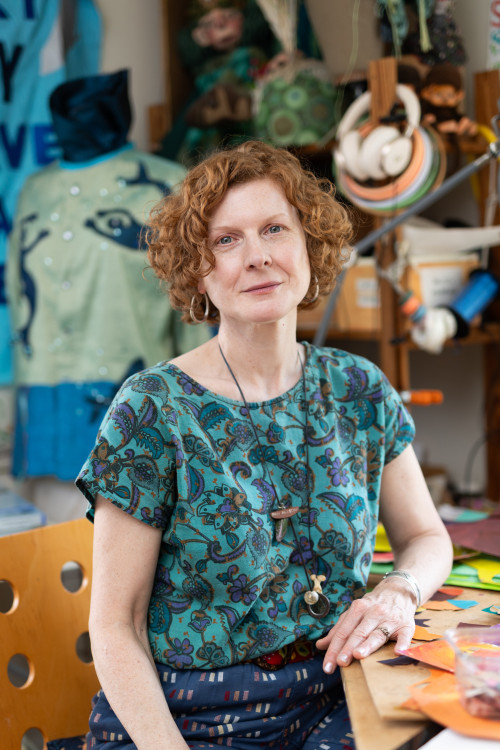
Elaine Roussos ’67, ’73 (Painting and Photography BFA), Donor
For some artists, creativity is a calling. For others, it is a way of life. For Elaine Roussos, it is both and so much more.
Over the course of a remarkable career, Roussos has been a painter, photographer, educator, art therapist, homebuilder, architectural draftsman, and entrepreneur. She has traveled extensively, painted landscapes across the country and abroad, built homes with her own hands, and spent more than three decades helping children with significant emotional and behavioral challenges discover the possibilities of creative expression. The common thread connecting these seemingly disparate pursuits is an insatiable curiosity and a willingness to learn something new.
Roussos’s story offers a compelling example of how an arts education can extend far beyond the studio, shaping not only a career but an entire approach to life.
Roussos arrived at MICA with an interest in painting and photography, ultimately earning her Bachelor of Fine Arts in 1967. But limiting herself to a single discipline was never part of her plan. She immersed herself in studio courses, studying drawing, painting, photography, silversmithing, puppetry, woodworking, architectural drawing, and ceramics. She even explored pottery, later exhibiting some of her work.
Roussos remembers studying with painter and MICA faculty member Raoul Middleman along with other faculty members whose teaching reflected a school in transition, where traditional artistic instruction was beginning to intersect with new ideas and approaches. She also remembers the people who made her education possible.
Putting herself through college required resourcefulness and determination. Having previously worked as a telephone operator, Roussos found employment operating MICA’s switchboard. The job provided income to purchase art materials, while supportive administrative staff helped her secure a scholarship that enabled her to complete her studies. Those relationships left a lasting impression, as did the freedom to explore a wide range of artistic disciplines. What Roussos could not have known was just how useful those additional courses would become.
Near the end of her undergraduate studies, Roussos began exploring the possibility of teaching. She discovered that she had already completed nearly all the necessary coursework and needed only a supervised teaching practicum. That opportunity took her to Washington, D.C., where she quickly developed a strong connection with the students and staff at her placement school. Although she had already received a job offer in her hometown of Baltimore, the Washington school invited her to join its faculty. Roussos accepted. This decision launched a 31-year career working with children facing serious emotional, behavioral, and developmental challenges.
Roussos’s role evolved into something far more expansive than conventional art instruction. She worked with children from preschool through junior high school, many of whom had limited access to formal art education. Rather than narrow her teaching to traditional drawing and painting, she introduced students to an extraordinary range of creative activities. In many cases, she was introducing children to skills she herself had not encountered until college.
“I spread everything that I had learned in adulthood,” she explains, recalling lessons in photography, filmmaking, woodworking, puppetry, and candle making.
Because her supervisor was not an art specialist, Roussos developed an unconventional approach to evaluating her lessons: she asked the students. After completing projects, she would ask which activities they enjoyed most, what they wanted to try again, and what they had learned. Their responses helped shape the curriculum. Her approach emphasized trust, respect, and meaningful engagement. Over time, Roussos became someone colleagues called upon when students experienced behavioral crises. She knew the children, understood their individual challenges, and had established relationships that often helped her reach them when others could not. That trust was among her most valuable accomplishments.
Success was also seen when older students, who she had taught and counseled, began teaching younger ones how to behave in her classroom.
Roussos eventually moved into program management, drawing upon her years of experience and familiarity with the staff and students. She continued her own education as well, completing a master’s degree at MICA in 1973, with studies that connected art education and work with children with special needs.
Throughout her career, she remained committed to the idea that creative skills could offer children something enduring, regardless of the circumstances they might face later in life. Even when she worried about the difficult futures awaiting some students, she hoped art would provide a constructive outlet.
“All students need is paper and pencil,” she says.
While Roussos’s professional life centered on education, her creative ambitions extended well beyond the classroom.
After her sister purchased property in West Virginia, Roussos visited the area and discovered a gently sloping parcel of land with a stream. She imagined building a home there. And she intended to build it herself.
“One of the reasons I took architectural drawing at art school was to eventually be able to build my own home,” she explains.
Working full-time in Washington, Roussos spent weekends constructing the house as her finances allowed. She paid off the land, arranged for a foundation, and gradually completed the framing, siding, windows, and doors. The project represented years of labor, patience, and determination.
Then disaster struck.
While Roussos was preparing for a weekend trip to Ocean City, Maryland, colleagues informed her that her house had burned down. A lightning storm was believed to have caused the fire, which destroyed the building and many of her possessions, including 26 paintings and photographs. It was a devastating loss.
But Roussos refused to abandon her dream. Instead, she decided to build again, applying everything she had learned from the first attempt. The second house eventually led to an unexpected business opportunity. Someone suggested that if she could build homes for herself, she might consider building them for others. Roussos embraced the idea. She began constructing houses as an investment for retirement, using her artistic training and practical experience to develop another career. Her architectural drawing skills also generated income when a local construction company hired her to prepare and modify building elevations.
What began as an art-school elective had become an essential professional tool.
Throughout her years as an educator and builder, Roussos never stopped painting. Travel became an important source of artistic inspiration. She explored much of the United States, visited Canada, and painted on the Greek islands while pursuing her master’s degree.
When possible, she worked directly on location. When circumstances prevented her from painting, she took photographs to use as references after returning home. Her artistic influences include Georgia O’Keeffe, Edward Hopper, and Vincent van Gogh, although she has never felt compelled to settle into one easily recognizable style. For Roussos, artistic development remains an ongoing process.
Despite decades of experience, she remains eager to discover new methods. More recently, she has revisited the instructional television series of painter Bob Ross, studying his wet-on-wet techniques and experimenting with approaches to landscapes, water, and atmospheric effects.
Her curiosity reaches well beyond art. Over the years, she has worked as a telephone operator, meat cutter, courier, advertising survey worker, and real estate agent. At her West Virginia property, she tends a garden, grows vegetables and fruit trees, and maintains the land using equipment acquired during her homebuilding years.
Boredom, it seems, has never been much of a concern.
Looking back, Roussos recognizes that MICA gave her far more than technical proficiency in painting or photography. It gave her a foundation for approaching unfamiliar challenges with confidence, curiosity, and imagination. These skills she learned found their way into almost every aspect of her life, from teaching children to designing houses, from pursuing new artistic techniques to creating opportunities for financial independence.
Her life demonstrates the lasting influence of an education that encourages students to explore beyond their immediate ambitions. And at an age when many people might be content to slow down, Roussos shows little inclination to stop.
“As long as I have life in me,” she says, “there will be something going on.”

Join the festivities as MICA honors its 200-year history, recognizes its present success, and looks forward to a bright future. Throughout 2026, the College will be sharing community stories and announcing one-of-a-kind events on campus, in Baltimore, and beyond.