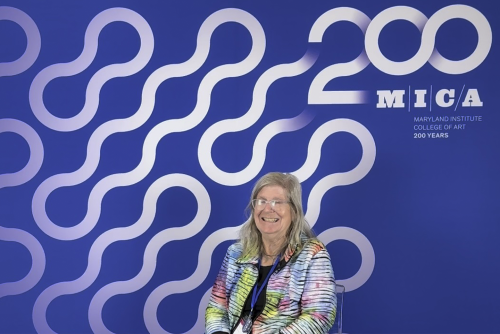
When Andrea “Remmi” Franklin first arrived in Baltimore in the early 1970s, she didn’t yet know she was walking into a community that would shape her creative language for life. The Massachusetts native had originally set her sights on the Museum School in Boston, but she was waitlisted, and then the school went on strike for two years. That unexpected detour turned out to be what Franklin now calls “the best decision I never planned.” Her mother encouraged her to consider a lesser-known but promising alternative — the Maryland Institute College of Art.
“MICA had just become accredited; it wasn’t yet famous nationally,” Franklin recalls with a laugh. “My mother knew somebody on the board who said, ‘Why don’t you apply?’ We came down, I loved it, and I got in.”
Back then, MICA’s footprint was small, a cluster of historic buildings and no dorms, but that scale fostered a sense of closeness that remains vivid in her memory. “Everyone knew everyone,” she says. “Baltimore was gritty and real, but MICA felt like this oasis of creativity in the middle of it.”
A Love of Color
What set MICA apart, Franklin says, wasn’t just its art instruction; it was the culture of experimentation and seriousness of purpose that students brought to their work. “I loved being here. It wasn’t about grades; it was about being immersed in art,” she says.
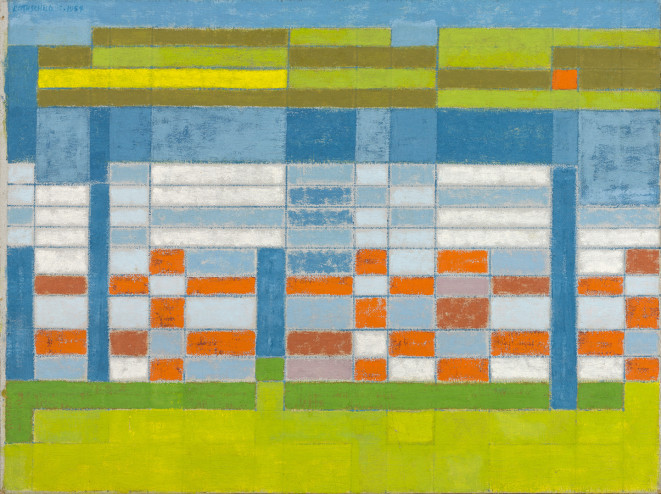
She remembers learning from teachers who encouraged and helped her push past hesitation and trust her instincts. “MICA gave me my love of color,” Franklin says. “I learned how one color affects another, how the brain reads combinations. I’d paint these large abstract works and think in weights: ‘Yellow is four grams.’ That thinking still shapes my art today. People still tell me, ‘Your color is amazing.’ That’s MICA.”
At a time when art schools were rigidly separated by discipline, MICA encouraged a fluid approach. “That’s what made it different,” she says. “You could explore — painting, printmaking, sculpture — and nobody said, ‘Stay in your lane.’ It’s what kept me engaged all four years.”
The Unexpected
Franklin’s life after graduation followed a winding, deeply human path, one that reflects both resilience and reinvention.
“I always tell people: my career didn’t go in a straight line,” she says. “It went wherever life needed me.”
As she raised three children, Franklin took part-time jobs that fit the rhythms of family life, from layout and design work in advertising to framing and freelance illustration. “My gripe about MICA back then,” she admits, “was that they didn’t teach us how to do résumés or portfolios. You had to figure it out yourself. I hear they do now, and that’s wonderful.”
Her most unconventional career turn came later in life: working at an Apple Store. “I’ve always loved computers,” she says. “Apple was this wonderful mix of technology, creativity, and energy. I was surrounded by young people and learning all the time. And when the first iPhone came out, Apple gave every employee one. I was the cool old lady at weddings with the first iPhone!”
But art has remained the through-line — and the anchor — of her story, especially through tragedy. Two decades ago, Franklin lost her daughter, who was also an artist. “She worked with paper; I painted,” Franklin says softly. “After she passed, I began incorporating her paper pieces into my paintings. It became our art. That’s how I became a mixed-media artist.”
Art became both remembrance and renewal. “If I could have her back, I’d give up art in a second,” she says, “but I love what I do now. I probably would have evolved in that direction anyway, but loss made it happen faster.”
Her other two children — one a woodworker, one a fellow artist — continue the family’s creative legacy. “Art still runs through all of us,” Franklin says. “It’s how we stay connected.”
The Same but Different
Today, Franklin sees a campus transformed yet familiar in spirit. On a recent visit, she was struck by how much has changed and how much still feels the same.
“When I was here, it was just a few buildings,” she says. “Now it’s this beautiful, expansive campus. But I hope MICA never loses that sense of community. That was so important when I was a student. You could feel that everyone — students and teachers — was in it together.”
She’s also heartened to see MICA led by its first woman president and to hear about the college’s continued emphasis on social and cultural engagement. “The world is changing every five minutes,” she says. “I think MICA’s heart — the care for its students and for art as a way of living — hasn’t changed at all.”
That enduring connection extends beyond campus walls. Franklin recalls a serendipitous encounter this past summer: “I was in Southampton, New York, talking to a man about restaurants. I told him I was an artist; he said he was an architect. I showed him my work, and as I was leaving, he asked, ‘Where did you go to school?’ I said, ‘MICA.’ He went silent because he went to MICA too! It’s a small world. If you talk long enough, you’ll always find a MICA connection.”
Explore and Create
For Franklin, MICA’s difference lies in the freedom to explore, and the lifelong community that exploration creates. “MICA taught me to see color differently, to think differently, and to live differently,” she says. “It’s not just about art; it’s about curiosity, discipline, and care. That’s the part that stays with you.”
Half a century after she first set foot on campus, Franklin still carries that sensibility into her studio. “MICA gave me the tools to find my own path, and the courage to keep walking it,” she says.