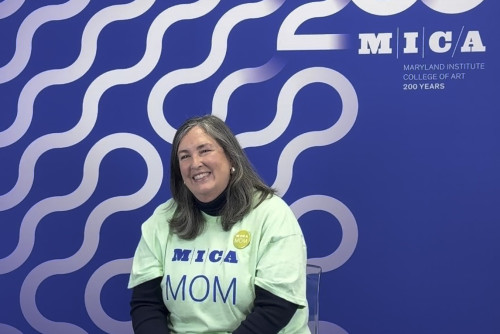
Kristy Tillman Knuppel spends her days guiding seventh graders through one of the most formative years of adolescence. A teacher at Dumbarton Middle School in Baltimore County Public Schools, she knows firsthand what it means to nurture young people as they discover who they are becoming.
That lens as an educator, mentor, and parent has shaped the way Knuppel experienced MICA. Knuppel and her husband are parents to three children: Lindsey, Martin, and Augie. Two of them found their artistic paths at MICA.
For her, MICA has not simply been a college her children attended. It has been a creative home, an incubator, and a partner in helping her children grow into confident artists and educators.
A Five-Year Journey: Animation to Art Education
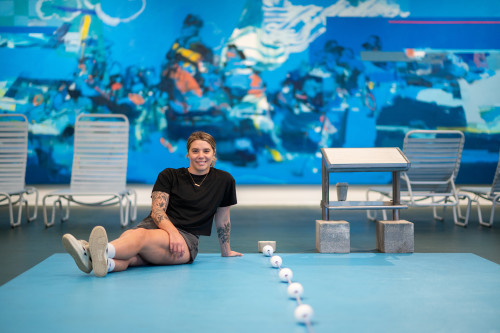
Knuppel’s oldest child, Lindsey, completed MICA’s five-year BFA-to-MAT program, earning her BFA in Animation in 2024 and her Master of Arts in Teaching in 2025. Along the way, she was a recipient of the A. Claire Gaskins Harper ’41 Scholarship.
Today, Lindsey is teaching middle school art and loving it.
“She absolutely thrives,” Knuppel says. “She’s building curriculum, helping shape what’s meant to become an art magnet program, and teaching her students animation. She’s confident in classroom management and lesson planning. MICA gave her such a strong foundation.”
The impact has come full circle. After more than 20 years in education, Knuppel recently pursued National Board Certification. Lindsey, fresh from her MAT coursework, helped coach her mother through elements of the process.
“She was helping me navigate new technology and assessment practices,” Knuppel explains. “It was amazing. She really learned both as an animator and as an educator.”
For a career teacher, watching her daughter embrace the profession, and do so with creativity and confidence, has been deeply rewarding.
The Bicentennial Senior
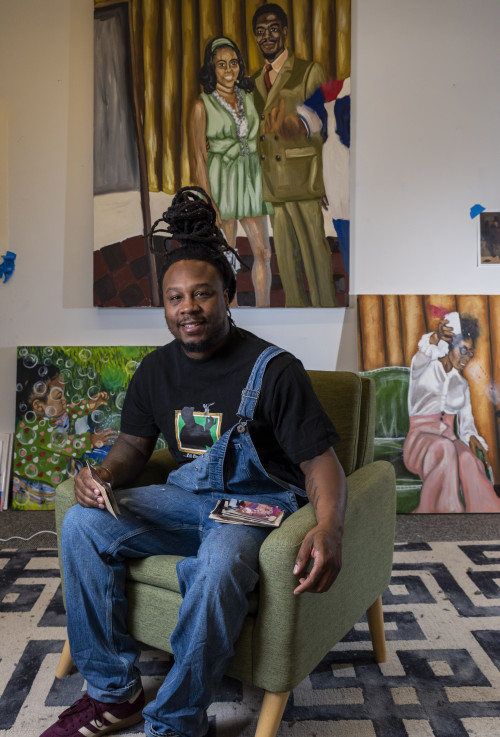
Her son, Martin Knuppel is part of MICA’s Class of 2026, the Bicentennial class, and a recipient of the Dale Burton Wood ’30 Memorial Scholarship. He is pursuing a dual major in Illustration and Printmaking, along with a minor in Book Arts/Sequential Arts.
“It’s an intense combination, especially at the senior level,” Knuppel says. “But MICA made it possible.”
From sophomore year on, Martin’s advisors helped him map out six-course semesters so he could successfully complete both majors. That individualized support stands out to Knuppel.
“The advising here is incredibly personal,” she says. “They knew he could handle it. They worked with him to build a schedule that would allow him to thrive.”
Martin’s interests range from graphic novels and book design to scientific illustration. He has applied for internships in scientific illustration, interns at Globe Press, and serves as a teaching assistant in a papermaking class.
“I could see him eventually becoming a college professor,” Knuppel reflects. “But I think he wants to be a working artist first. MICA has given him the tools and the confidence to follow wherever his creativity leads.”
Access and Investment
For Knuppel, scholarships were essential. Both Lindsey and Martin received merit-based aid when they enrolled. Lindsey also earned a competitive scholarship during her senior year based on her junior-year work, an additional $11,000 that significantly reduced her financial burden.
“That was such a gift,” Knuppel says. “It’s not just ‘you’re in, here’s your aid package.’ MICA continues to invest in students once they’re here. That speaks volumes.”
She was also struck by how many students she met who had received competitive scholarships after enrolling.
“It shows that MICA believes in retaining its students and supporting their growth,” she says. “That matters.”
A Family Legacy
MICA is woven into Knuppel’s family history in unexpected ways. Her brother, Robert Tillman, is a printmaking professor at the College. And her grandfather’s second wife, Louise Mullen Flanagan, a 1934 graduate, endowed a scholarship that still supports students today.
“There’s a real legacy [at MICA],” Knuppel says. “It feels special to see that continue.”
Grace During Uncertainty
Lindsey began her MICA journey during the COVID-19 pandemic. Like many families, the Knuppels faced uncertainty about whether to begin college online or defer.
“MICA handled that turbulent time with such grace,” Knuppel recalls.
Students were offered flexible options, start online, defer a semester, defer a year. International students could take synchronous classes at unconventional hours to remain connected. Advisors and financial aid officers held Zoom meetings with families to answer questions and provide reassurance.
“Even though it was a difficult time globally, we felt supported,” she says. “The flexibility and care were remarkable.”
Lindsey chose to begin online, and the transition ultimately proved seamless.
An Incubator of Creativity
Ask Knuppel what it means to be a MICA parent, and her answer comes quickly: “You get to see your kids shine.”
She describes MICA as an incubator, one where creativity is not only encouraged but amplified.
“The spotlight isn’t on one student, it’s on all of them,” she says. “Professors bring out even more than you thought your child had inside them.”
As an educator herself, she appreciates the fact that many MICA faculty are working artists.
“The students deeply respect them,” Knuppel says. “And the maker spaces invite experimentation. You’re encouraged to jump in and create immediately.”
Even campus life left an impression. Lindsey and Martin lived in Leake and Meyerhoff, enjoying apartment-style housing with private bedrooms and shared living spaces.
“That sense of community is unmatched,” Knuppel says. “And as a parent, you’re invited in to exhibitions, Art Market, festivals, the Bicentennial celebration. You feel connected.”
Advice to Other Parents
When speaking with prospective families, Knuppel is candid. “MICA will see your child for who they are, and who they’re becoming,” she says. She believes MICA meets students where they are and evolves in response to their interests.
“It’s not prefab,” Knuppel explains. “Programs shift based on student needs. Advisors and faculty nurture the whole student.”
Her advice? Visit campus. “You’ll feel the spirit immediately.”
Watching Them Grow
For a teacher who has dedicated her life to helping young people discover themselves, watching her own children grow within MICA’s creative ecosystem has been especially meaningful.
“They take sparks of ideas and turn them into sculptures, paintings, films,” Knuppel says. “They collaborate. They inspire each other.”
Ultimately, Knuppel sees MICA’s impact as extending far beyond campus.
“The world needs their creativity,” she says. “MICA nurtures it, gives it wings, and lets it fly farther than you imagined.”
Two hundred years into its history, she believes MICA continues to fulfill that mission of creating space for ideas to grow and artists to flourish.
“I just want to say thank you,” Knuppel says. “To every person at MICA who helped nurture our kids and their creativity. The world needs the art — and the heart —that comes out of this place.”