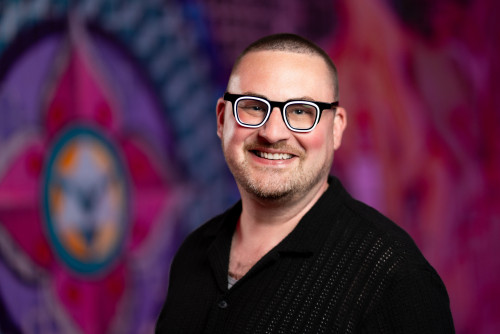
Matthew Power met MICA the way many Baltimoreans do—by passing through it. For 16 years, his commute from Charles Village to 301 Preston Street cut straight through Bolton Hill. Seasons changed, semesters turned over, and Power could practically read the academic calendar on the sidewalks: new-student buzz in September; clusters of artists heaving canvases and mammoth portfolios in December and May; the visible cocktail of worry, pride, and relief that marks a critique day. He didn’t know their names, but he watched them grow.
“Students felt like walking works of art,” he says, “fashion-forward, unmistakably themselves, unmistakably committed.” That daily glide through a corridor of creativity became a ritual: a reminder, before he ever entered higher education, that MICA is not a campus set apart from the city; it’s a current running through it. The impression stuck. Long before he would represent Maryland’s independent colleges as MICUA’s president, he’d already formed an affinity for MICA’s energy, its presence, and its people.
An Urban Tapestry
Ask Power what distinguishes MICA within the constellation of 15 independent colleges he represents, and he doesn’t hedge. “It’s not just what makes it distinct—MICA is distinct,” he says. Part of that difference is geographic: MICA is Baltimore through and through. Rather than a manicured quad behind gates, the College is stitched into neighborhoods. Historic buildings are repurposed into studios and maker spaces; new spaces invite not only students but also collaborators, entrepreneurs, and neighbors. “There’s no more intriguing urban campus landscape in the country,” Power argues. “Bolton Hill is the place it is because of MICA.”
He points to Station North and decades of Artscape as emblematic of the College’s civic posture—creative, catalytic, and embedded. That embeddedness is not ornamental, it’s structural. Power believes MICA respects the historical fabric of Baltimore while insisting that old buildings can house new futures. Adaptive reuse, executed with both architectural appropriateness and artistic imagination, has become a signature move. The result is not a campus in a city, but a campus that is city: block by block, studio by studio, culture by culture.
Underneath the bricks and beams is an older continuity. Power returns to the College’s longevity as proof of concept: 200 years is not inertia, it is adaptation—the creative instinct to read the horizon and prepare for it.
“MICA is the oldest for a reason,” he notes. “It adapts, innovates, and stays relevant across two centuries of change.” For Power, that’s the MICA difference: a community that treats creativity not as ornament but as an operating system.
Advocacy, Buildings, and the City They Shape
Power’s role lets him translate admiration into outcomes. As MICUA president—and previously as vice president—he helps Maryland’s independent colleges secure state capital dollars for construction and adaptive-reuse projects. With MICA, he’s seen how public investment multiplies. “When a MICA project comes in, everyone wants to support it,” he says. The College leverages state grants to create spaces that are historically sensitive and stunningly contemporary, with studios and commons that invite public life as much as student work. There are at least eight MICA buildings with state dollars in the mix, he notes, each a visible argument for what art can do in a neighborhood.
Walk the campus with Power and he’ll narrate the before-and-after: vacant shells turned into humming hubs; once-forgotten corners now bright with possibility. “It’s phenomenal and contagious,” he says. Schools can build for themselves; MICA builds in a way that lifts the block.
The impact isn’t only architectural. Power sees the College’s alumni as a second engine. The stereotype—painters and sculptors only—misreads the output. MICA graduates do that, yes, and they also found startups, design games, architect experiences, lead creative tech teams, and seed Baltimore’s maker economy. They launch businesses across the city and state, then give back to the place that sparked their innovation.
“Entrepreneurship at MICA doesn’t get enough credit,” Power says. “Students transform the campus when they’re there, the city when they leave, and industries well beyond.”
That flywheel—place made stronger by people; people made bolder by place—helps explain a civic consensus that’s rare in Baltimore: “There are few things everyone agrees on,” Power says, “but everyone roots for MICA. As MICA goes, so goes the city. As the city goes, so goes MICA.”
Carrying the Difference into the Next Century
Bicentennials are for looking back, but Power is more animated by what comes next. He believes MICA’s habit of anticipating change positions it not just to keep up with the future, but to make it. Whether through new programs that meet emerging fields or through classical foundations that launch students into 22nd-century work, the College’s cadence is the same: find what’s next, build for it, and invite the community along.
He imagines a conversation at MICA’s Tricentennial. People will ask how a 19th-century art school managed to remain so relevant in the 21st and 22nd centuries. The answer, he says, will be the same then as now: brilliant, creative minds—students, faculty, alumni, administrators—seeing patterns early and making places that let those patterns become practice. In short, MICA will keep doing what only MICA does.
Go For It
Power’s counsel to prospective students is disarmingly simple: follow your passion. He’s met enough MICA alumni to recognize a pattern. Whether they’re leading studios or startups, curating galleries or building games, they don’t regret their undergraduate experience. What they learned—creative discipline, collaborative muscle, the habit of critique, the nerve to risk—travels. “They wouldn’t trade the friendships, the creativity, the innovation they experienced on campus,” he says. If you come, you’ll find faculty and staff who are all-in, peers who push you, and a city that invites you to matter.
A Sure Bet
From the beginning of Power’s relationship with MICA—windows-down drives through a living gallery—to his current vantage point as MICUA president, the throughline is clear. MICA’s singularity isn’t just about rankings or reputation. It’s about a way of being in a city; a habit of turning old buildings into new opportunities; a belief that artists are entrepreneurs, neighbors, and builders; and a willingness to bet on the next thing before it’s obvious.
That is why, when a MICA project appears in Baltimore, support rallies. It’s why Station North looks the way it does. It’s why alumni keep reshaping industries and why Baltimore, in a city that seldom agrees on anything, agrees on this: MICA matters.
Two hundred years in, the College remains what Power first witnessed through a windshield—an open-air invitation to create, to belong, and to build the future in public.