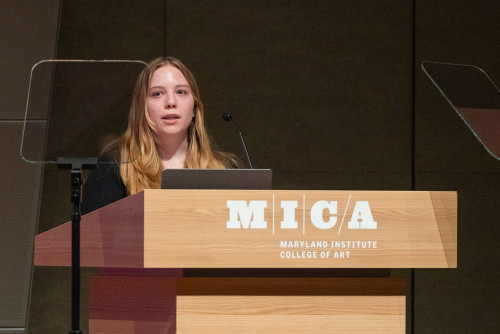
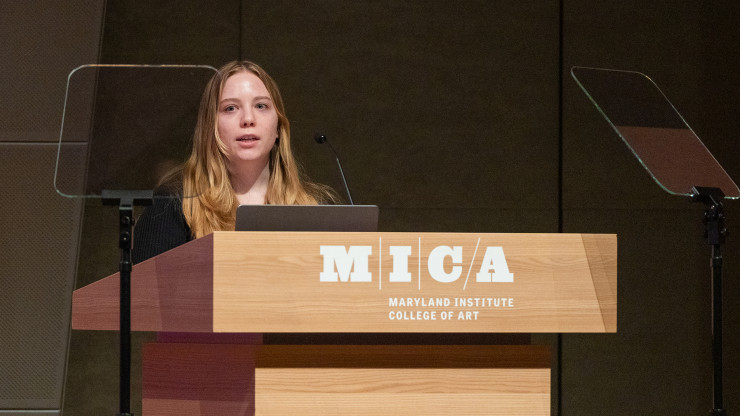
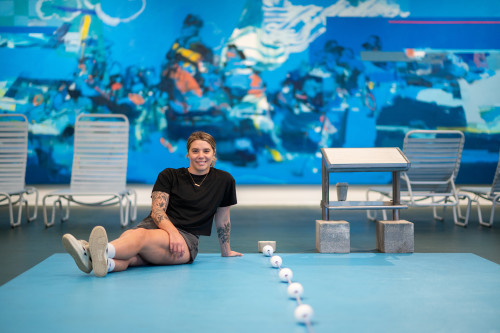
At MICA’s Bicentennial Opening Celebration, the spotlight didn’t land on a finished object so much as a work in progress: an artist building a practice in real time. Student speaker Alexandra “Alex” Ozga stepped forward to the podium on January 21, 2026, to describe a path that doesn’t fit neatly into any one department, because it was never meant to.
“Transferring to MICA was a turning point in my artistic practice,” Ozga told the audience. “It gave me the resources, trust, and interdisciplinary environment to turn my ideas into reality. Not just individual projects, but a practice that connects art, science, and entrepreneurship.”
That practice has a name: Wild Clay Ceramics, Ozga’s sustainability-focused studio project and emerging business, rooted in place-based materials and a deep curiosity about how ecosystems, especially in Maryland, can be understood through the language of clay, glaze, and form. Working toward a Ceramics degree (BFA ’27) and enrolled in MICA’s five-year BFA/MAT program, Ozga plans to transition directly into completing a Master of Arts in Teaching after the undergraduate degree. The goal is not simply to make pots — or to teach, or to research — but to braid those pursuits into a single life’s work.
A detour that became the map
Ozga’s route to ceramics began with a love for the material in high school and a seemingly different future in mind. “It definitely wasn’t a straight path toward art,” says Ozga. “I did ceramics in high school, and I really loved it, but I always thought that I was going to do environmental science.”
Ozga applied to colleges for environmental science and assumed the plan was set. Then the plan cracked, quietly at first, then all at once. “Something just changed,” Ozga says. “I knew that I wanted to [do ceramics], but I didn’t know how to get there.”
Instead of forcing a choice between interests that refused to separate, Ozga slowed down. Community college became a bridge rather than a pause: time to keep studying environmental science while continuing ceramics, and space to figure out what the work could become when both halves were honored. Her associate degree from Montgomery College opened the door to reapplying widely, but it was MICA that felt like a fit the moment Ozga arrived.
Meeting with faculty and transfer advisors, seeing how credits would translate, and mapping out a trajectory made the difference between imagining a future and actually building one. “And I’m here now,” Ozga said. “It’s amazing. I love it so much.”
Connectivity
Ask Ozga to describe how environmental science, ceramics, education, and entrepreneurship can live in the same studio, and the answer comes quickly: they were never separate in the first place.
“They’re all kind of interconnected,” Ozga said. “When you think about concepts like STEAM… it is so connected. And then on top of that, ceramics is literally a piece of the earth.”
For Ozga, that’s not a metaphor; it’s a material fact. Wild Clay Ceramics incorporates wild-harvested clays and local byproducts such as discarded oyster shells, and it experiments with algae collected from the Chesapeake Bay as a glaze ingredient. The work is place-based in the truest sense: a practice in which the geography of Maryland becomes the raw data.
The environmental focus isn’t decorative; it’s structural. Harmful algal blooms, fueled by nutrient pollution and warming waters, are not only an ecological crisis but also a lens into how communities relate to their waterways. Ozga explains that turning that crisis into a ceramic glaze doesn’t “solve” the problem, but it does propose a new kind of attention: one that asks viewers and users to hold environmental realities literally in their hands.
“People want not only pots,” Ozga said, “but… beautiful pieces of art that they get to use every day that also tell a story.” In Ozga’s world, a bowl can be a conversation starter. A mug can be a reminder. A table setting can be a kind of field note.
From Bay to kiln
Ozga’s relationship to the Chesapeake Bay is personal, rooted in Maryland childhood memories and community-based environmental work. But it’s also scientific. “
I’ve always had that connection to the water and the harbor,” Ozga says, recalling experiences like planting wild rice as a Girl Scout and learning firsthand what stewardship can look like.
With that connection comes clear-eyed awareness of what the Bay faces: shoreline erosion, dead zones, fish kills, summer blooms that disrupt ecosystems and livelihoods. “It really depletes the oxygen in the water,” Ozga notes.
The question that followed was one Ozga now returns to again and again: What can an artist do? Not in the abstract, but specifically. Practically. Collaboratively. Accountably.
An internship with Johns Hopkins University helped turn that question into a method. Ozga collected harmful algae in the summer, brought samples back to the lab, processed them into ash, and analyzed the material to better understand what it contains and how it might behave in a ceramic glaze.
Today, that research continues through collaboration, work that Ozga also highlighted in the Bicentennial speech, referencing partnerships that make this kind of cross-disciplinary practice possible. Ozga’s path has included support from programs and spaces that encourage experimentation at the boundaries: MICA’s UP/Start program, the BioFabrication Lab, and external research relationships that connect ceramics to environmental science and material analysis.
Waste streams, reimagined
Wild Clay Ceramics is built on a simple, radical premise: local waste and local ecological challenges can be reimagined as usable materials, without losing the story of where they came from.
Oyster shells, for example, are often discarded by restaurants. But in glaze chemistry, calcium carbonate is a known ingredient; when shells are cleaned, crushed, and ground, they become more than leftovers. They become an opportunity.
Ozga is also exploring additional regional material streams through partnerships, research, and collection efforts that point to a practice shaped by collaboration as much as by studio solitude. Each new ingredient brings a new set of questions: How should it be processed? What does it contribute chemically? What does it communicate culturally? What responsibilities come with using it?
The studio, for Ozga, is not only where objects are made. It’s where research is tested, where lab knowledge meets kiln logic, and where the ethics of material sourcing are part of the design process, not an afterthought.
Education at its center
Wild Clay Ceramics is not just an art practice; it’s an entrepreneurial project designed to scale impact without diluting meaning. Ozga’s functional work — bowls, pitchers, teapots, tableware—meets a real audience desire for daily-use objects that carry artistic presence and environmental purpose. And that demand helped push the project toward business.
Ozga’s early momentum was recognized through Just Start, a program supporting emerging business ideas, where Ozga received award funding for the project. She is also a participant in UP/Start, continuing to develop Wild Clay Ceramics with mentorship and resources that address what many artists are rarely taught: the behind-the-scenes realities of building a sustainable studio business: insurance, legal structures, websites, taxes, branding, and all the invisible scaffolding that supports the visible work.
Importantly, Ozga’s vision for entrepreneurship doesn’t end at sales. The long-term aim is community education, workshops where participants can learn processes, make their own pieces, and understand the environmental narratives behind the materials. It’s a model where art becomes both product and public-facing pedagogy.
A future in the classroom
While Wild Clay Ceramics grows, Ozga is also preparing for a future in the classroom. That’s not a pivot away from the studio; it’s an extension of it. “Teaching has always been part of my life,” Ozga says, describing experiences teaching summer classes and working with young people.
Ozga speaks about art education the way many artists speak about their medium: with gratitude, specificity, and a sense of mission. A high school ceramics teacher helped make Ozga’s current life possible. Now Ozga wants to become that kind of teacher for someone else, someone who creates a studio space that is inclusive, welcoming, and big enough for multiple identities and ways of working to thrive.