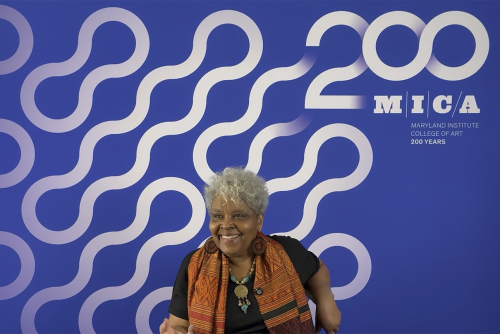
For Oletha DeVane ’76 (Painting, BFA), who grew up in Baltimore, art was not a hobby but a constant companion. She was “one of those kids always in the art room,” guided by a high school teacher who saw her potential and suggested MICA. With the help of a scholarship and work-study, she arrived at Mount Royal Avenue as a teenager, eager but untested.
The early 1970s were turbulent years for the country, and DeVane recalls that there were only a handful of students of color on campus. “You could count us on one hand,” she says. Even so, she was not discouraged. “That wasn’t the guiding principle for me. I loved making friends, even though I was a pretty quiet kid. Most of my time at MICA was spent learning what the space was about.”
Nurturing Across Boundaries
What made MICA different was the way faculty nurtured her curiosity across boundaries. “For the most part, the faculty here really took students under their wing,” recalls DeVane. While she majored in painting, she was drawn to poetry and writing. “I was always interested in things that were unusual, not just painting, but how conceptual ideas could be brought together across disciplines.”
That interdisciplinary spirit became central to her identity as an artist. At MICA, she learned not only technique but also the habit of asking questions without easy answers. “There were always questions that were asked, and there weren’t any answers except you had to find them on your own, which was lovely.”
At a time when other institutions defined artists by medium—painter, sculptor, printmaker—MICA’s openness allowed her to see herself simply as a visual artist. That freedom was both empowering and formative.
The Ripple Effect
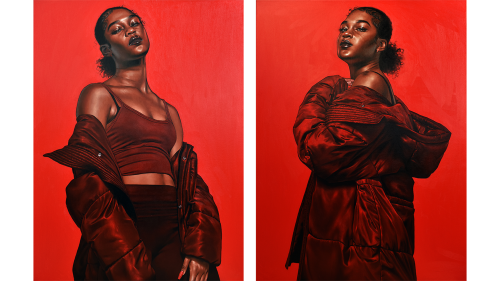
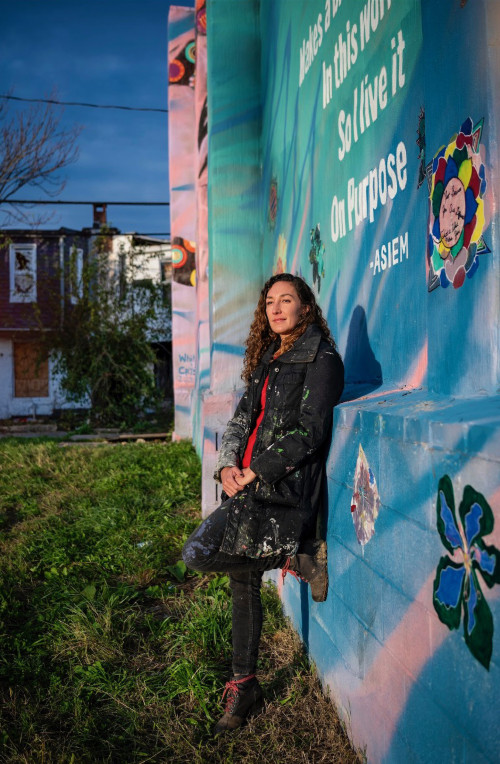
The impact of that difference rippled through DeVane’s career. She became known for work that spans painting, installation, sculpture, and public art, often addressing social, political, and spiritual themes.
Her education at MICA prepared her to navigate those complexities. It also gave her mentors who introduced her to African art and history, broadening her understanding of her role as an African American artist. “In the very early ’70s, I began that whole exploration into what it meant to be an artist committed to a field and understanding my role as an African American,” she recalls, crediting the influence of professors like Leslie King Hammond, PhD, graduate dean emerita and founding director of the Center for Race and Culture at MICA.
That grounding enabled DeVane to create powerful works such as Witness, which addressed the history of lynching in Maryland, and her memorial to the enslaved and freed at McDonogh School. In both projects, she wove historical research with community engagement and a spiritual sensibility inherited from her parents. “The broadness of [MICA’s] education taught me that there’s a connection between disciplines,” she says. “That’s something I’ve carried with me all my life.”
Beyond her studio practice, she became a teacher and curator, committed to making art a vehicle for community dialogue and healing. In her words, “We’re here to serve each other, and the arts are a vehicle for understanding the social complexities of our society.”
Do the Work
As MICA celebrates its 200th anniversary, DeVane reflects on the role of alumni in carrying forward that spirit of openness, inquiry, and social engagement. “Anyone who’s in a position to support the kind of education MICA offers should at some point give back,” she says. “That doesn’t have to do with money; it’s about what you can provide, depending on where you are in your career. It’s about service.”
Her advice for today’s students is simple but urgent: “Try to ignore this idea of becoming famous. Don’t even think about it. If you’re going to do the work, do the work. If you care about what it is, you do—do it.”
For DeVane, MICA’s uniqueness lies in its ability to cultivate artists who think beyond themselves, who explore across disciplines, and who use their art to connect with the world. That ethos, she believes, is both rooted in Baltimore and resonates far beyond it. “MICA is like no other because it encourages artists to ask the hard questions, to make connections across boundaries, and to carry those lessons into their communities.”
Embodying the MICA Difference
From a 17-year-old student of color navigating an unfamiliar campus in the 1970s to a nationally recognized artist whose work grapples with history and spirituality, DeVane embodies MICA’s difference. Her story shows how a school that embraces interdisciplinarity, nurtures curiosity, and challenges its students to seek meaning beyond the studio can shape not just careers but lives of impact.