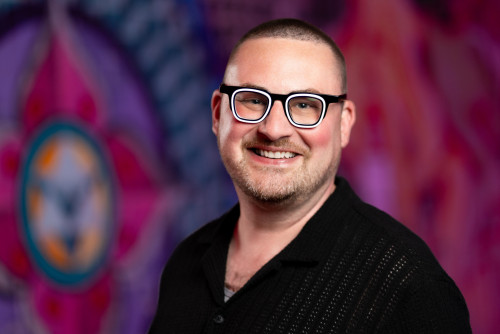
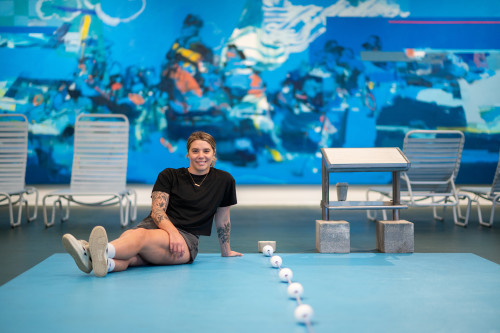
Lucas Cowan believes public art should do more than decorate a skyline or fill an empty plaza. At its best, he says, it can help cities listen to themselves by amplifying local voices, strengthening community identity, and making space for creative life to flourish in public. As a curator and arts and cultural policy consultant with more than 18 years of experience, Cowan has built a career at the intersection of placemaking, cultural strategy, and civic partnership, always returning to a simple guiding aim: creating systems that give artists the money, space, and time to do what they do best.
That philosophy has guided Cowan’s work across the country, from major civic parks to statewide cultural initiatives, and now to his role as curator of the Millennium Park Foundation in Chicago. A graduate of MICA’s fiber department (BFA ’03), he embodies the kind of creative life the college seeks to cultivate rooted in rigorous studio practice yet propelled outward into neighborhoods, institutions, and public life through community, collaboration, and a firm belief that art belongs in the public realm, shaping not only what art looks like but how communities experience it.
The MICA Atmosphere
Ask Cowan what he remembers most from his time at MICA, and he doesn’t choose a single moment so much as an atmosphere. “Really, all of it,” he says. “I was so involved in everything from being a fibers major to being a project manager for student affairs, working with admissions as a tour guide. I just took everything that MICA had to offer and did it.”
That kind of wide-angle participation — studio, campus life, community-facing work — became a blueprint for the way Cowan would later move through cities and institutions. Even then, he was less interested in operating as a solitary maker and more drawn to the conditions that allow creative work to thrive.
A pivotal turning point arrived through community engagement projects, as MICA was developing what would eventually become Community Art Partnerships (CAP). “It was actually just an after-school, after-curricular activity,” Cowan recalls. “And it was through those projects that really got me interested in the connection to the arts in the public, especially the arts and the public realm.”
He still remembers the visceral “aha” of that early work. During a neighborhood parade, part festival, part joyful disruption, Cowan found himself helping push a giant, student-made shopping cart down the street. It was full of people dressed as chickens. “To see the kids, especially being part of something so different and part of their neighborhood,” he says, “it started clicking.”
He loved studio practice. But something about participatory art felt like an opening: a way to offer creativity as a shared experience, rather than a private one. “That was really what drove me in my next steps toward public art and cultural policy work.”
From “plop art” to public trust
Over the past 18+ years, Cowan has built a national career across public art programs, cultural planning initiatives, and large-scale civic projects. His résumé moves through major institutions and complex civic ecosystems, including a range of consulting roles supporting communities and cultural initiatives.
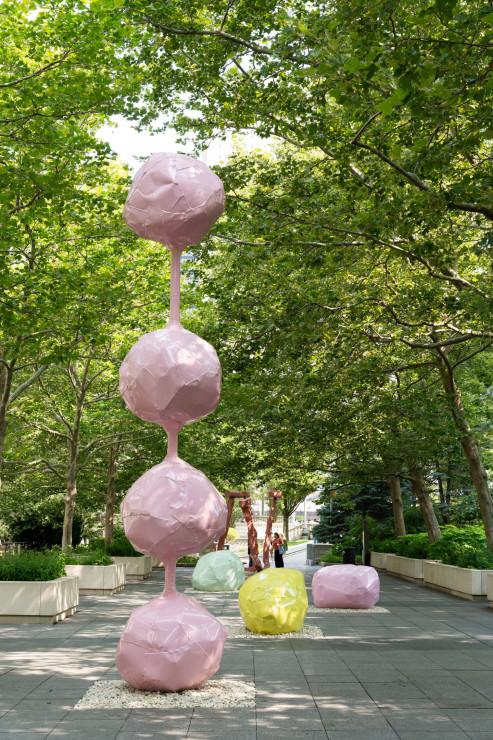
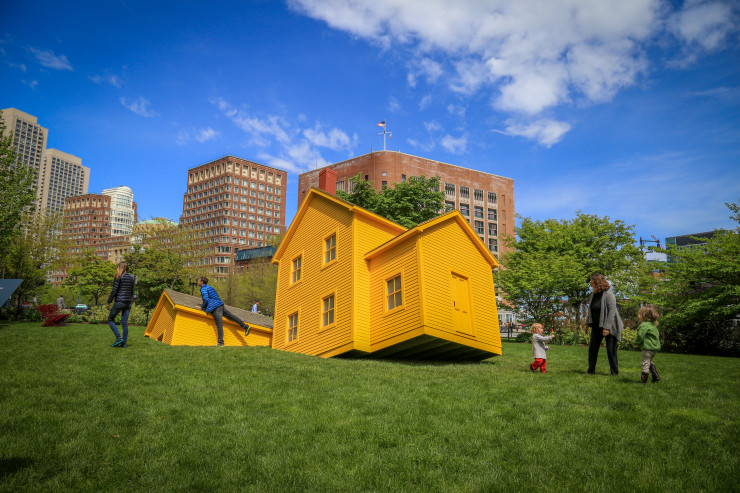
In each setting, Cowan has advocated for a more expansive view of what public art is and what it can do. “Public art has changed considerably over the last 30 years,” he says. Where it once leaned toward “plop art,” a sculpture placed outside as decoration, today’s best work is tied to civic needs, social realities, and public dialogue. It is a celebration and critique. It is healing and provocation. It is, at its best, a form of public trust.
That trust depends on something Cowan returns to repeatedly: listening. In municipal and rural communities, especially, he says, the work cannot succeed if city leaders arrive with a plan and leave out the people who have been doing the work all along.
When art is used improperly, when it becomes the friendly face of displacement, listening is often what’s missing. Cowan names the risk plainly: artists can be positioned as the vanguard of gentrification, making a neighborhood feel “cool,” then getting priced out of the very place they helped animate. His approach is to keep the cultural “gatekeepers” (in the neutral sense of that word: the caretakers, bearers, and builders of local culture) at the table and to ensure that growth includes growth for artists, too.
A translator between worlds
Cowan’s work sits at the intersection of curatorial practice and cultural policy, and he speaks fluently across the stakeholder landscape: artists, funders, civic agencies, developers, and community members. He sees his role as a kind of ethical translation.
“You need someone who can talk to the people, who can talk to the artists, who can talk developer talk, who can talk municipal talk,” he says, “but can also protect each of those areas.”
The whole package
Cowan’s advice for artists coming out of school is deeply practical: learn the ecosystem. Know how funding works. Learn the basics of negotiation and contracts. Understand that professional survival may require more than galleries and private commissions. He wants artists to see public art not as a niche reserved for sculptors, but as a wide platform that can hold illustrators, painters, fiber artists, and designers, anyone willing to translate their medium into a public context.
“MICA gave me so much pride,” he says. “It was collaborative. It wasn’t competitive. Public art is not the work of one artist; it’s a village.”
And in that village, whether it’s a campus parade, a city park, or a community in crisis, Cowan has spent nearly two decades building the conditions for creativity to matter: not just as an object to admire, but as a way people find one another.