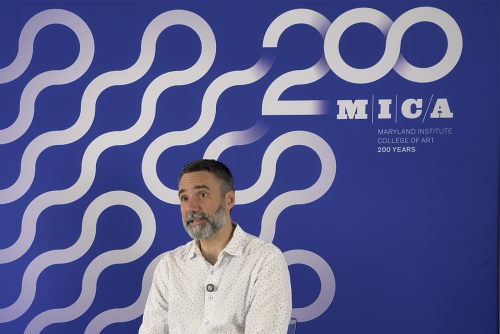
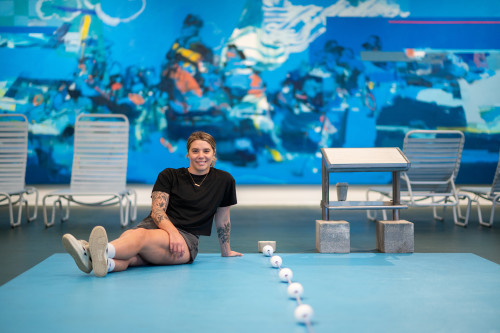
When Ryan Hoover arrived at MICA as a graduate student, teaching wasn’t on his horizon. He was a maker—rooted first in woodworking and craft, then stretching into sculpture, code, microcontrollers, and digital fabrication. But a graduate teaching internship he took shifted everything. “MICA made space for difficult questions in the studio,” Hoover says. That experience didn’t just open a door to the classroom; it gave Hoover a blueprint for an entire practice, one that treats learning as inquiry, collaboration, and ethical responsibility.
Today, Hoover is a full-time faculty member in Interdisciplinary Sculpture and an alum of the Mount Royal School of Interdisciplinary Art (MFA ’06). His scholarship lives at the intersections of digital, biological, and traditional media, where students explore emerging technologies while wrestling with their social and ecological implications. As MICA celebrates its 200th anniversary, Hoover’s story illuminates a throughline that defines the College then and now: this is where creativity meets consequence—and where artists help set the terms for how new technologies meet the world.
Coming to MICA
Hoover’s relationship with MICA began as many do—with a studio practice searching for a bigger frame. His path sharpened his appetite for experimentation, and his teaching internship crystallized a distinct pedagogy. Here, serious theory belonged in the studio; rigorous making belonged at the center of tough conversations.
The effect on Hoover was twofold. First, it revealed the kind of educator he wanted to be: someone who invites students to wrestle with complexity and equips them to do so responsibly. Second, it set the stage for where his practice would travel next, into the logics of code and machines, and ultimately into collaborations with living systems.
Those roots in MICA’s culture of inquiry prepared Hoover to return as faculty and begin building something genuinely new on campus: a laboratory and curriculum where artists could engage biotechnology not as outsiders offering critique from the sidelines, but as skilled collaborators shaping methods, metaphors, and applications from within.
What Makes MICA Different
Ask Hoover what makes MICA unlike other schools, and he points to the way the College starts things and trusts students with them. “From the beginning, MICA made space for hard questions,” he says. “Students weren’t shielded from complexity; they were invited into it.” That ethos extends far beyond seminar tables. It’s embedded in the Interdisciplinary Sculpture program’s embrace of materials and processes, and in the College’s willingness to build infrastructure that turns inquiry into practice.
When Hoover and colleagues proposed MICA’s first bio lab and a biofabrication course nearly a decade ago, skepticism was easy to find. Let undergraduates work with living systems? Teach artists wet-lab techniques? Yet the College backed the idea, precisely because it aligned with MICA’s mission to redefine the boundaries of art and design. Once the work was visible, doubt gave way to momentum.
Hoover also names a difference in how disciplines touch. In many universities, design and engineering are paired as problem-solving fields, while art and science are seen as distant cousins. MICA flips that script. Hoover sees art and science as partners because both are “question-oriented” and thrive in ambiguity. That alignment invites artists to approach biology not as a toolset to be mastered and applied, but as a conversation—one that respects the agency of living systems, insists on ethical attention, and asks what futures we should grow.
Impact in the Studio and Beyond
The proof is in the projects. Hoover’s students routinely balance sophisticated technique with careful conceptual framing, one reason MICA teams have earned top honors at the Biodesign Challenge while also producing strong work that matters beyond prizes. That balance derives from the studio’s dual commitment: learn the skills to make and cultivate the judgment to decide why and how to make.
The lab itself functions as a classroom for both biology and citizenship. Hoover urges students to treat it as a site for experimenting with relationships, with each other and with nonhuman collaborators. Working with bacteria or cell lines requires more than protocols; it demands sensitivity, patience, and a form of listening not reducible to language. “There’s a kind of intimacy you develop with living systems,” he says. “You learn to perceive when something’s off, the way you can sense a friend is upset before they say a word.” That attentiveness becomes an ethical habit, training artists to approach ecosystems, materials, and communities with respect.
Curricularly, the new undergraduate Co-Major in Biodesign makes pathways visible. Students can pursue research-based experiences on externally funded projects, explore commercially oriented tracks (including startups), or chart entrepreneurial routes of their own. Hoover notes that many leading biomaterials companies were founded by artists and designers, a reminder that the field’s next breakthroughs won’t be authored by engineers alone. Artists bring a different analytic toolkit: thinking in material, form, and relationship; prototyping metaphors that shape how society understands and stewards technology; and keeping ecological systems in view alongside economic ones.
Those metaphors matter. Hoover points out how deeply synthetic biology has been guided by the metaphor of DNA as code. It has been a powerful frame and an incomplete one. Artists are good at holding both truths: using metaphors to move a field forward while questioning what those metaphors simplify or erase. That reflex can help the bioeconomy avoid repeating the extractive patterns of the digital era—where attention and identity became raw materials to be harvested and resold.
Baltimore is a crucial arena for this work. The region’s biotech landscape has long focused on health and the body—domains marked by complex biopolitics and inequitable histories. MICA introduces a complementary vantage: using biology to make differently—developing materials and processes that are lower-toxicity, more energy-savvy, and collaborative with ecological systems rather than exploitative of them. Hoover sees the city poised to lead as other regions invest in biodesign; MICA’s studios and labs can be connective tissues linking researchers, startups, community partners, and policy conversations.
For Hoover, MICA’s bicentennial is both a celebration and a calibration. “It feels like looking forward to year 300,” he says. But the look ahead echoes a very old story. In the 19th century, the Maryland Institute for the Promotion of the Mechanic Arts emerged in a Baltimore transformed by steam engines, railroads, and new alloys. The Institute helped a city—and a country—learn how to live with those technologies, shaping not only what could be built, but how people imagined distance, time, and possibility.
Biodesign is a comparable hinge point. The tools are different and the stakes more planetary, but the animating question is familiar: what does it mean to be human, together, amid a technological shift? MICA’s answer, then and now, is to prepare artists who can make with integrity and think with consequence, who can collaborate across difference and species; who can hold the lab and the neighborhood in the same frame; who can craft not only objects and systems, but metaphors and ethics.
That’s the echo Hoover hears and the future he’s helping to build: a College that continues to start things; that equips students with skills and sensibilities; that treats the studio and lab as places to practice the worlds we want to inhabit. In that future, MICA graduates won’t merely take jobs in the creative industries or the bioeconomy. They’ll shape those fields—founding companies, guiding research, partnering with communities, and insisting that the making we do serves the flourishing of people and planet alike.
In Hoover’s words, the goal is not just to make things differently, but to live differently while we make—to cultivate collaboration, care, and curiosity as core competencies. That is the promise of biodesign at MICA, and the reason the College remains like no other: a place where artists learn to grow futures, not just artifacts.