 + Enlarge
On The Cover: Fall 2026
At 200, MICA celebrates its creative evolution and looks to the future with meaningful impact.
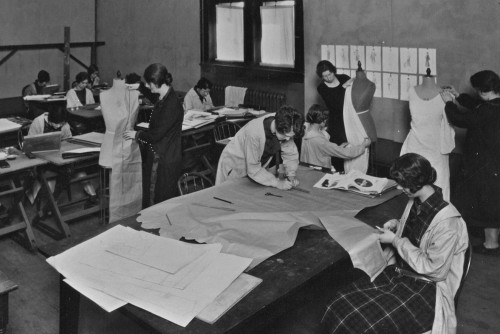
The studio is quiet, but not still.
Fabric pools at Kai Nunnally’s feet, stitched, pinned, and shaped into garments inspired by Baltimore’s buses and trains, the fleeting choreography of strangers in motion. In the fashion studios of MICA, observation becomes design, and everyday life becomes material.
“At MICA, I became interested in applying illustrative concepts to textiles and discovering how repetition can create complexity,” said Nunnally, a 2026 Fiber and Experimental Fashion graduate whose work explores identity, memory, and the city.
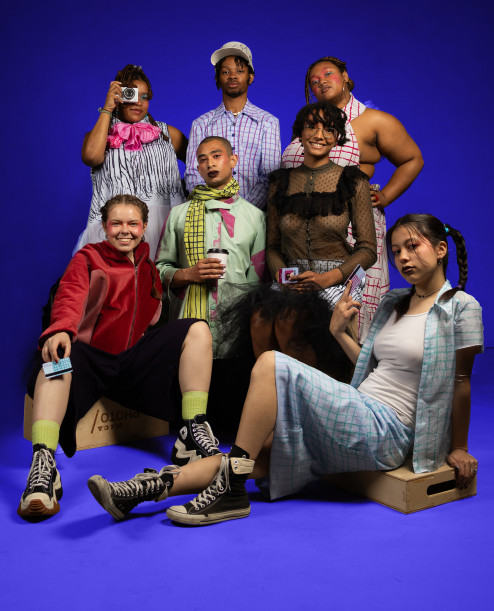

Down the hall, in MICA’s biodesign lab, students cultivate materials. Sheets of bacterial cellulose dry while mycelium spreads across organic matter, blurring boundaries between art, science, and sustainability. “What’s unique here,” said biodesign professor Ryan Hoover, “is that the goal isn’t innovation for its own sake. It’s about making, questioning, and letting those two things guide you somewhere unexpected.”
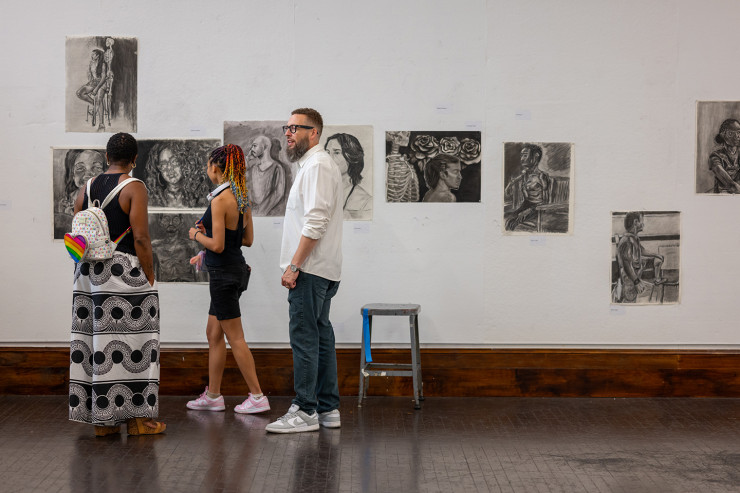
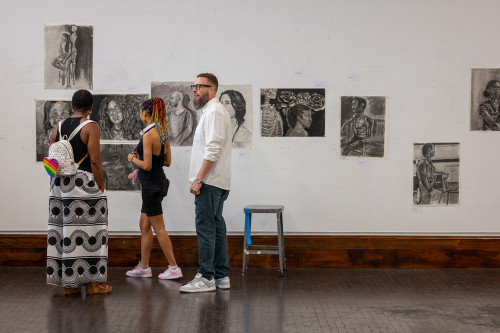
In Main, Anna Rossi (’27 Painting, BFA) builds portraits layer by layer in charcoal and oil, drawing on close mentorship and freedom to move across disciplines.
“When I first arrived, I immediately saw how different the method was,” Rossi said. “Everyone was welcoming and approachable. If you ask for help, you’ll always find it.”
Together, these spaces tell the story of MICA at 200: an institution where art is not confined to one medium, one discipline, or even one definition. For two centuries, MICA has asked what art can do. Today, the answers are unfolding everywhere.
In 1826, Baltimore was a city in motion, with its harbor bustling. The Maryland Institute for the Promotion of the Mechanic Arts was founded with a mission to connect art, craft, and industry in service of a changing world.
From the beginning, the institution that would become MICA was rooted in the belief that creative skill had a role in manufacturing, design, and everyday life. Early programs emphasized drawing for artisans, mechanical design, and applied arts. Art was not separate from industry; it was embedded within it.
That orientation helped position the Institute as a formative force in American art education. As the country industrialized, the Institute evolved alongside it, adapting its curriculum, expanding its scope, and redefining what it meant to prepare artists for the world they were entering. MICA responded again and again to the needs of its moment. Adaptation became part of its identity.
MICA’s bicentennial arrives at a moment of transformation and innovation. “Creativity is a commodity that cannot be automated, outsourced, or depleted,” said President Cecilia M. McCormick. “And what we have to do is turn that creativity into impact.”
That idea of impact has become a defining thread across the institution, shaping how students learn, how faculty teach, and how the college positions itself within Baltimore and beyond.
For Kristian Bjørnard ’09 (Graphic Design MFA), chair of Graphic Design and Product Design, that change begins with a question.
“What if the first thing we ask isn’t how to design something,” he said, “but whether it should exist at all?”
“What if the first thing we ask isn’t how to design something, but whether it should exist at all?”
–Kristian Bjørnard ’09
Bjørnard describes himself as a “sustainabilist,” someone who considers how design decisions affect users and broader ecosystems. His students consider materials, lifecycles, and consequences, imagining products that can be disassembled, reused, or even avoided entirely.
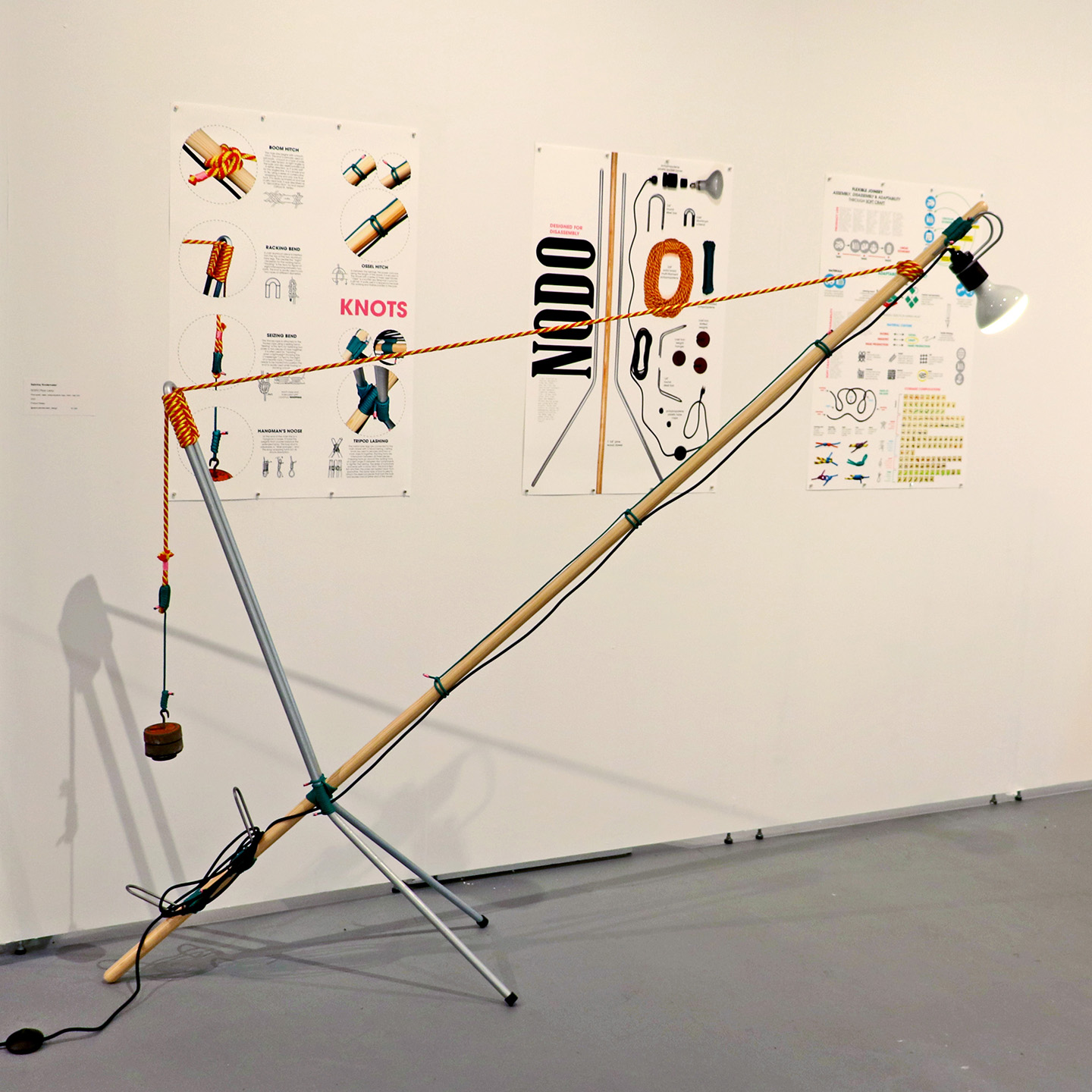
That thinking takes form in projects like Sabrina Kindervater’s modular lamps. A 2025 Product Design graduate, Kindervater researched and tested more than 120 types of knots, evaluating their structural performance, ease of tying and untying, aesthetics, and ability to withstand friction and force. She then applied select knots in her final “Nodo” lamp design, eliminating screws, adhesives, and permanent fasteners. Each piece can be taken apart and reassembled, reflecting principles of a circular rather than linear economy.
“I wanted to rethink how things are put together, and what happens when we’re done with them,” she said. Her work is practical, showing how small shifts can change systems.
That systems-level thinking extends beyond the classroom and into the city.
“We’re an anchor institution,” McCormick said. “That means we have a responsibility to be part of the city’s growth.”
That philosophy is taking shape through MICA’s Design + Innovation Hub, a strategic initiative announced during the bicentennial launch. The Hub connects programs, centers, labs, faculty expertise, and outside collaborators, establishing pathways for creative work to engage communities, industries, and the broader creative economy.
Lee Davis and Michael Weikert, co-executive directors of MICA’s Center for Creative Impact (CCI), are key partners in that effort, helping structure collaborations that bring students into engagement with the city. “It’s not about designing for people,” Davis said. “It’s about designing with them and staying engaged long enough for that work to matter.”
That approach is evident in CCI’s multi-year Jones Falls Watershed initiative. Partially buried and often overlooked, the Jones Falls River runs through part of MICA’s campus and Baltimore’s history. Students, faculty, and alumni are working with organizations including Blue Water Baltimore and the Friends of the Jones Falls to reimagine the watershed as an ecological and cultural asset, transforming neglected properties into classrooms, galleries, and green spaces.
“Faculty and students have long been engaged in meaningful, real-world work, but those efforts often relied more on individual initiative rather than a designed system,” Weikert said. “The goal now is to make that work central to the student learning experience, embedded in faculty teaching, and foundational to how MICA engages with Baltimore.”
“The goal now is to make that work central to the student learning experience, embedded in faculty teaching, and foundational to how MICA engages with Baltimore.” – Mike Weikert
Drawing from disciplines including product design, biodesign, animation, architecture, social design, and entrepreneurship, the Hub supports partnered courses, applied research, community initiatives, and venture development.
“It’s about building a pipeline,” Weikert said. “From ideas to action to impact.”
McCormick sees that structure as essential to MICA’s next century. “We want students to have real-world engagement every year,” McCormick said. “To build not just skills, but confidence.”
“We’re an anchor institution ... That means we have a responsibility to be part of the city’s growth.” – Cecilia M. McCormick
In the biodesign lab, that confidence comes from designing relationships.
Mantis Harper, a 2024 Ceramics graduate who now works as a MICA lab technician and participated in the 2024 Biodesign Challenge, remembers when the program occupied a corner of a room.
“Even a couple years ago, people didn’t really understand what biofabrication was,” Harper said. “But this community of people was deeply invested, not just in the work, but in each other.”
Trained in ceramics, Harper found a connection between craft and biology through their shared attention to material, process, and transformation. Her Biodesign Challenge project, “Symbiotic Stitches,” explored how mycelium could create textile-like patches dyed with lichen. The project centered on collaboration between people, humans, and organisms.
“How do we practice care with the materials we’re working with?” Harper asks. “How do we think of them as collaborators?
“It was one of my favorite experiences at MICA,” she said. “It changed how I think about making.”
Hoover sees that shift as essential.
“Students aren’t just learning techniques,” he said. “They’re learning how to think differently about materials, about systems, about their role in the world.”
gallery alley, a project led by Davis, is a physical manifestation of MICA’s role in the world, an open-air space where art, ecology, and community intersect. More than an exhibition site, it serves as a platform for ecological storytelling, neighborhood revitalization, and interdisciplinary collaboration.
Through CCI initiatives like Jones Falls 2076, students and collaborators imagine the watershed’s future 50 years from now, inviting advocates, scientists, civic leaders, and residents to rethink environmental futures creatively.
Recent Curatorial Practice MFA graduate Taro Cantú ’26 has helped shape gallery alley alongside Davis while developing her thesis as a live, site-based performance. Together, they collaborated with alumni, faculty, students, and community partners to transform the alley into a creative space celebrating its cultural and ecological heritage.
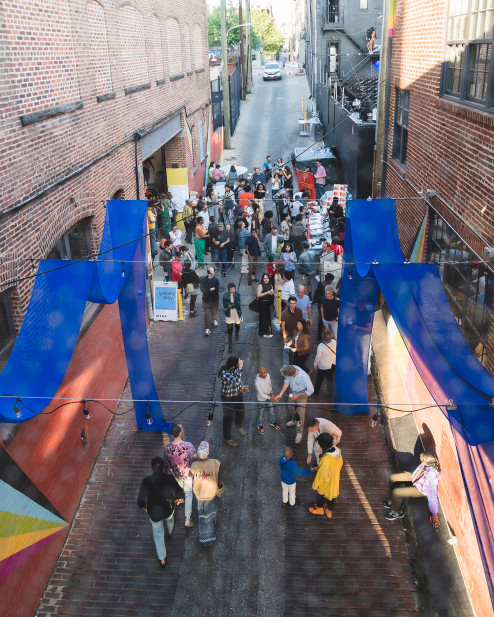
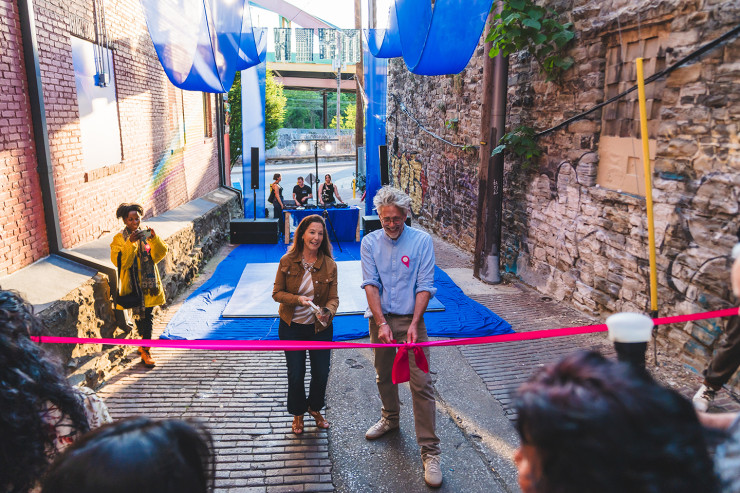
Other alumni and students contribute in tangible ways. “Color Rays,” a mural by Jaz Erenberg ’17 (Interdisciplinary Sculpture BFA), uses bold, radiating bands across alley facades to reflect the layered cultural identities of the neighborhood. Recent graduate Nic Amsel ’26 (Rinehart School of Sculpture MFA) has been commissioned to create work for gallery alley while assisting with professional installation. Product design students are exploring functional elements such as outdoor seating, integrating usability with environmental considerations.
What began as a single mural installation has grown into a broader vision: a pedestrian space with public art, native landscaping, sustainable stormwater systems, and infrastructure for performances and community events. The alley becomes both canvas and classroom, a place where ideas are tested, disciplines converge, and the neighborhood is a co-creator.
The connection between creativity and impact is perhaps most visible in MICA’s entrepreneurial ecosystem.
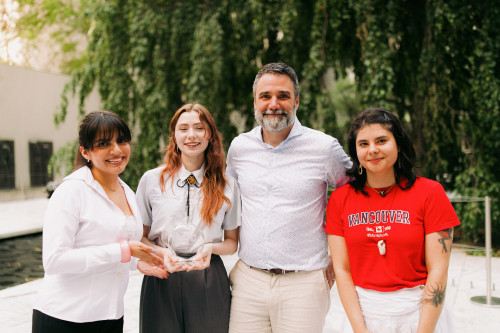
Through the UP/Start Venture Competition, students and recent alumni receive funding and mentorship to develop creative businesses. This year’s winners range from Flying House Arts Collective, which activates underused spaces for community art programming, to Heavy Feather Productions, a creative agency focused on storytelling for underrepresented voices.
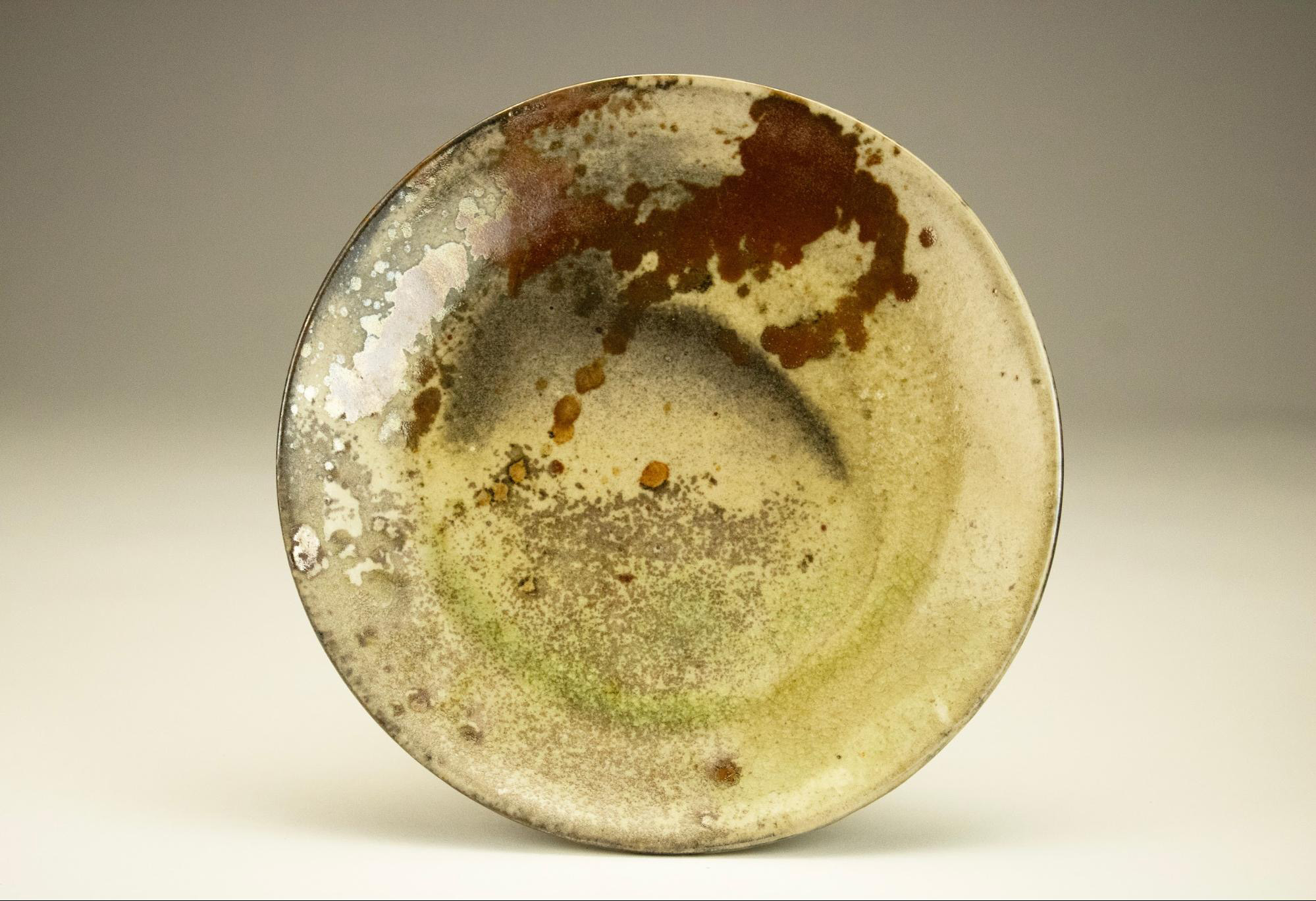
Wild Clay Ceramics, founded by graduating student Alexandra Ozga ’26 (Ceramics BFA, MAT ’27 candidate), transforms materials like oyster shells, algae blooms, and iron runoff into functional ceramics, bridging environmental science and craft.
“I want to make something that has a purpose beyond itself,” Ozga said.
The ventures share a belief that creative work can generate cultural and economic value.
For alumni like Jack Flame Sorokin, that thinking carries far beyond campus.
A 2015 photography graduate, Sorokin returned to his former home in Marshall, North Carolina, after Hurricane Helene devastated the town. Initially planning to help with cleanup, he was encouraged by fellow MICA alumnus Frank Lombardo ’02 (Painting BFA) to document what he saw.
“Frank told me the most impactful thing I could do was photograph it,” Sorokin said.
He captured both destruction and resilience: buildings reduced to debris, but also communities coming together to rebuild. His images were published nationally, bringing attention to a small town that might other-
wise have been overlooked.
“This is a community worth investing in,” he said. For Sorokin, photography became advocacy.
For alumnus Graham Coreil-Allen ’10 (Mount Royal School of Art MFA), advocacy takes shape in the built environment. A public artist, urban designer, and founder of Graham Projects LLC, Coreil-Allen transforms streets, sidewalks, and intersections into spaces that prioritize accessibility, safety, and community connection.
His approach began at MICA, where interdisciplinary exploration encouraged him to see the city as both studio and classroom. Drawn to Baltimore’s do-it-yourself culture and civic energy, he experimented with video, walking tours, performance, and urban planning, merging public art with social infrastructure.
One early intervention happened outside MICA’s Main Building. Noticing pedestrians naturally crossed diagonally through a faded intersection, Coreil-Allen and collaborators created a temporary diagonal crosswalk and directed traffic by hand. The unsanctioned project tested how design might change behavior and improve safety.
Design is a form of public care, one that can reshape how people move through and experience their neighborhoods. “The classroom and the city talk to each other,” – Graham Coreil-Allen ’10
Today, Graham Projects collaborates with neighborhoods to create artistic crosswalks, murals, wayfinding systems, and public spaces. In Reservoir Hill, Coreil-Allen’s “Seasonal Turn” project combined street murals, curb extensions, and redesigned crossings to improve visibility and pedestrian access near a community farm and bus stop. Residents helped shape the project through workshops and online voting.
“The classroom and the city talk to each other,” Coreil-Allen said of his MICA experience.
“The best art doesn’t preach the truth, It encourages viewers to discover what truth is on their own.” – Shinique Smith ’92, ’03
For alumna Shinique Smith ’92, ’03 (General Fine Arts BFA, Mount Royal School of Art MFA), that impulse toward connection takes a different form.
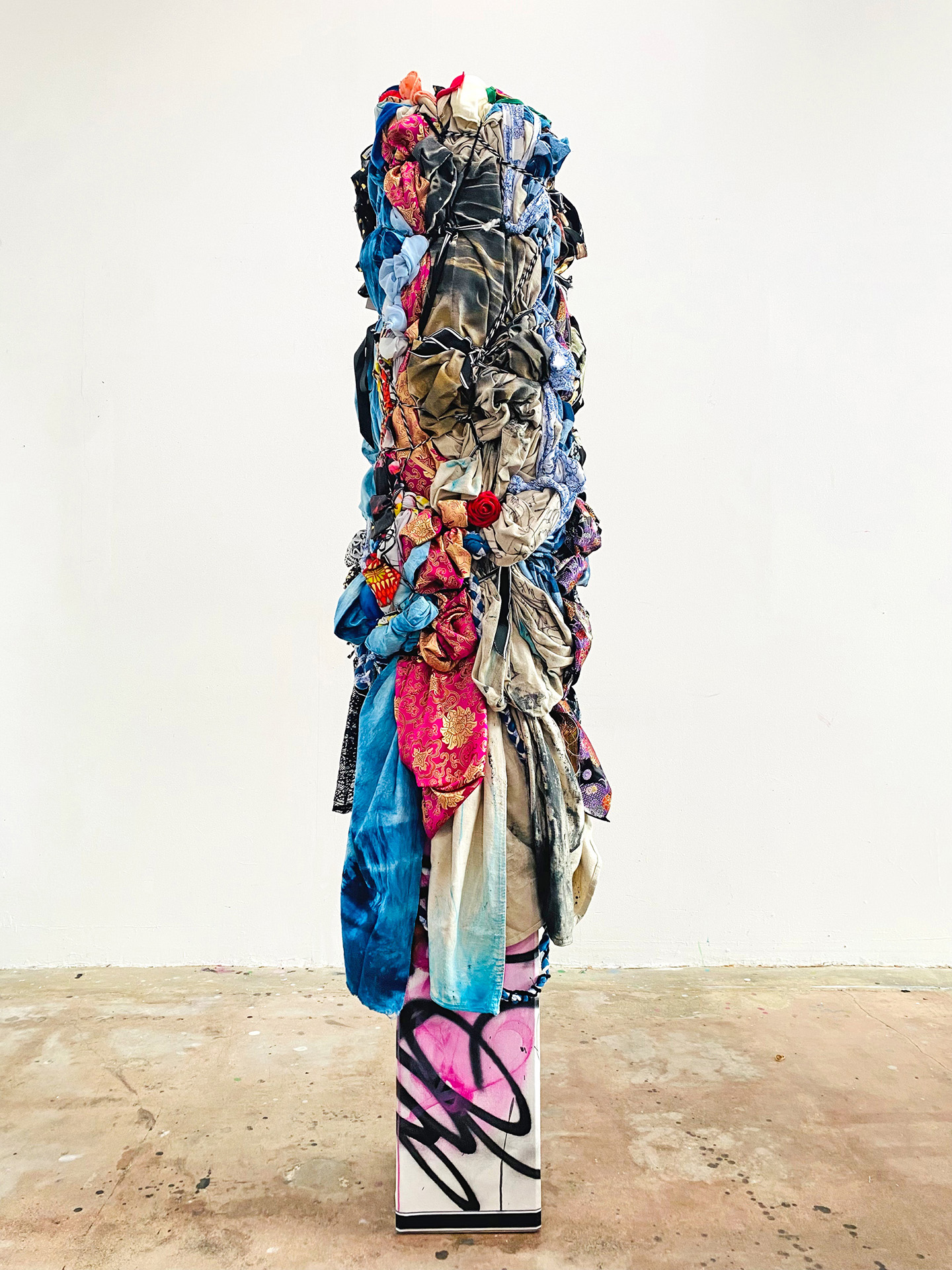
An internationally acclaimed multidisciplinary artist, Smith transforms clothing, textiles, paper, and personal objects into abstractions exploring memory, movement, and care. Born in Baltimore and based in Los Angeles, she has exhibited at institutions including the Whitney Museum of American Art, Boston’s Museum of Fine Arts, and the Solomon R. Guggenheim Museum.
“Each piece starts with touch,” she said. “A reverent attention to the histories these materials carry.”
Smith entered MICA at 16, where the General Fine Arts program gave her freedom to explore across disciplines.
“MICA undergrad for me was about finding myself,” she said.
After working in film and education, she returned for her MFA in the Mount Royal School of Art, where interdisciplinary practice and community helped define her direction. Today, her work transforms the everyday into vessels of personal and collective history.
“The best art doesn’t preach the truth,” she said. “It encourages viewers to discover what truth is on their own.”
Like Sorokin and Coreil-Allen, her work reflects a belief that art can connect people to place, one another, and overlooked ways of seeing.
As MICA looks toward its next century, that belief is guiding its vision.
McCormick defines the themes of its bicentennial — illumination, innovation, and entrepreneurship — as celebratory and strategic.
“Illumination means making visible the work happening within the institution and its impact beyond it. Innovation reflects the continued expansion of disciplines, from film and game design to biodesign and sustainability. And entrepreneurship ensures that students leave not only with ideas, but with the tools to bring those ideas into the world,” she said.
At the center is the student experience.
“We want students to have real-world engagement every year,” McCormick said.
Today, the questions are more complex. The systems are more interconnected. The stakes are more visible. Yet the work remains.
To imagine. To create. To shape what comes next.
And at MICA, that work, carried forward by students, faculty, staff, and alumni, continues to evolve.
Year by year, 200 years and counting, MICA’s legacy is still being made.
+ Enlarge
 + Enlarge