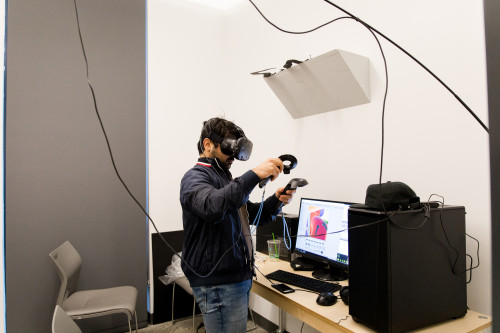
The Master of Professional Studies (MPS) in Game Design at MICA is a 30-credit, fully online graduate degree for designers, educators, developers, and storytellers who are ready to lead in one of the fastest-growing industries in the world.


|
|
Spring, Summer, Fall Intakes |
|
|
100% Asynchronous Online |
|
|
$40,500 total (30 credits) |
|
|
18 Months |
|
|
Master of Professional Studies (MPS) Credential |
In 18 months, you'll develop a specialization, complete a capstone project, and graduate with a professional portfolio and a master’s degree that reflect your skills to build stories and design playable games that connect to how people learn and engage.
MICA’s newest MPS program is built with the success of more than a decade of graduate education for working professionals. The MPS in Game Design follows the MICA tradition of rigorous, mentor-supported education that is structured for real life.
The fully asynchronous, 8-week course format is designed around professional and personal schedules. There are no time zone conflicts and no in-person visits required. The flexible, asynchronous format means you can advance your career without leaving your job, your city, or your current creative practice.
The MPS in Game Design integrates artistic vision, interactive systems design, and production leadership into one cohesive degree. You’ll get a faculty and industry mentor network and a cohort of peers working across game design, education, and technology.
You'll choose a specialization track aligned with your career goals, complete a capstone experience that mirrors a professional production from first concept to final deliverable, and graduate with a portfolio that reflects your future profession.
All students begin with a shared foundation in play theory, systems design, and narrative. From there, you choose one of four specialization tracks that align with your goals:
For artists, illustrators, and environment designers ready to lead with creative vision. You’ll build skills in visual storytelling, 3D asset creation, and style direction across game genres and platforms. Career paths for graduates: Art Director, Technical Artist, Environment Artist, UI/UX Designer
For designers focused on mechanics, interactivity, and flexible systems. You'll develop and test original gameplay concepts with faculty and peer feedback. Career paths for graduates: Gameplay Designer, Systems Designer, Interaction Architect.
For producers, managers, and entrepreneurs focused on building games and leading teams. You'll work through the production lifecycle with an emphasis on decision-making and studio operations. Career paths for graduates: Producer, Product Manager, Studio Director, Project Lead.
For educators, instructional designers, and UX professionals applying game mechanics to learning environments, workforce training, health outcomes, and social impact. This track is one of the fastest-growing areas in game design. Career paths for graduates: Learning Experience Designer, Gamification Strategist, Serious Game Designer, Educational Technology Innovator.
Every MPS in Game Design student completes a two-course Capstone sequence — Game Studio I and Game Studio II — that simulates a professional production from concept to launch.
By the time you graduate, you will have produced:
A fully playable game prototype
A professional Game Design Document (GDD)
A production roadmap and usability testing report
A portfolio-ready marketing and pitch deck
Faculty and industry mentors review your work at each milestone. You leave with production-ready deliverables that demonstrate your creative authorship and production leadership.
Foundations (9 credits): All students complete the following three courses.
Applied Game Theory for Designers
Game Systems, Mechanics & Prototyping
Narrative, Character & Worldbuilding for Games
Track Specialization (9 credits): Three courses within your chosen track, culminating in an applied studio project.
Professional Electives (6 credits): Choose from one-credit, micro-elective modules on topics including Artificial Intelligence (AI) and emerging game technologies, sound design, ethics and diversity in game design, UI/UX optimization, playtesting methods, and indie game publishing — or complete a three-credit Game Industry Residency tied to a professional conference such as GDC or IndieCade.
Capstone Sequence (6 credits): Two courses Game Studio I: Concept & Pre-Production and Game Studio II: Production & Launch
Total: 30 credits | 18 months
Game design has expanded well beyond entertainment. MICA MPS in Game Design graduates are prepared to enter or advance anywhere that interactive design, systems thinking, and applied play have a role.
Field |
Example Roles |
|
Game Design & Development |
Game Designer, Systems Designer, Narrative Designer, Level Designer |
|
Production & Leadership |
Producer, Project Manager, Product Owner, Studio Director, Indie Developer |
|
Visual & Technical Art |
Art Director, Technical Artist, Environment Artist, 3D Asset Specialist |
|
Education & Training |
Learning Experience Designer, Corporate Trainer, Instructional Designer |
|
Creative Entrepreneurship |
Independent Studio Founder, Creative Consultant, Content Creator |
According to the U.S. Bureau of Labor Statistics, Video Game Designer roles are projected to grow 7% or more through 2034 — faster than average. Maryland alone projects 9,100 new game design and related job openings over the same period, with a median annual salary of $98,090. Training and Development Specialists — the primary career path for graduates in Track 4 (Gamification, Learning & Applied Game Design) — are projected to grow 11% nationally, with a median annual salary of $73,220 in Maryland.
An MPS degree positions you for the 24% of posted positions that specify graduate-level, advanced credentials, and makes you uniquely qualified for leadership roles in studios, education, and enterprise.
100% online and asynchronous — no required campus visits, no synchronous sessions
8-week course terms — structured, focused, and manageable alongside full-time work
Cohort-based production studios — work collaboratively without requiring real-time availability
Faculty mentorship and industry feedback - happen at every milestone
Optional Game Industry Residency - professional conference immersion
The MPS in Game Design is designed for mid-career and emerging creative professionals with prior experience in fields in visual art, illustration, animation, graphic design, narrative writing, digital media, software development, education, instructional design, or corporate training. Prior game design experience is not required.
Program tuition: $40,500 total (30 credits)
Financial aid options for graduate students include institutional scholarships, federal loan eligibility, and employer tuition reimbursement programs. The net cost of attendance for many students is significantly lower than the published tuition rate.
For detailed cost and financial aid information, visit theTuition & Fees page.
Receive information about the benefits of our Master of Professional Studies programs, the courses you'll take, and what you need to apply. Check your email for the next steps.
The program is designed to be completed in 18 months across four semesters. The fully online, asynchronous format allows working professionals to complete the degree without interrupting their careers.
No. The Foundational Core establishes a shared design vocabulary for all students regardless of prior game design experience. The program is designed for creative professionals from a range of backgrounds including visual art, design, education, writing, and technology.
The MPS in Game Design is 100% online and asynchronous. No required campus visits or synchronous sessions. The optional Game Industry Residency involves professional conference such as GDC or IndieCade, but it is not required for degree completion.
You will graduate with a fully playable game prototype, a professional Game Design Document, a production roadmap, usability testing findings, and a portfolio-ready pitch deck. These production-ready deliverables are ready for employer or industry presentation.
Yes, that is how this program is designed. The asynchronous, eight-week course format allows you to manage coursework around professional and personal schedules without requiring real-time availability.
The MPS is a professional degree designed for applied outcomes and career advancement. It is accelerated, practice-focused, and built around portfolio-ready deliverables. An MFA is typically a terminal fine arts degree with a longer program duration and a research or thesis focus. If your goal is to advance in the game industry or transition into it without a multi-year, residential commitment, the MPS is the right choice for you.
If you are a working creative professional who wants a master’s degree, a production-ready portfolio, and access to a mentor and peer network without stopping your career, the MICA MPS programs are the right investment for your future. MICA's MPS programs are built on a decade of success that has demonstrated over and again that this educational model works. The degree opens doors to leadership roles and advanced positions that portfolio work alone often doesn't.
The program offers four tracks: Visual Design and Art Direction, Game Design and Interactive Systems, Production Leadership and Strategy, and Gamification, Learning and Applied Game Design.
The total program tuition for 30 credits is $40,500. Financial aid, scholarships, and employer tuition reimbursement may significantly reduce the net cost. Contact Graduate Admissions for your personalized cost and aid estimate.
MICA is accredited by the Middle States Commission on Higher Education (MSCHE) and is an accredited institutional member of the National Association of Schools of Art and Design (NASAD). The Maryland Higher Education Commission approved the Maryland Institute College of Art to offer the degree, MPS in Game Design.