
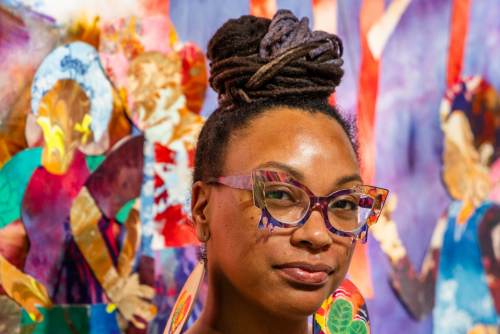
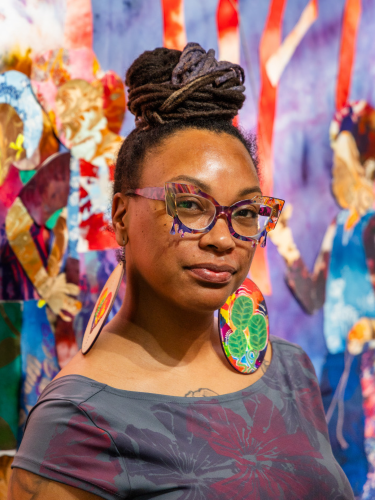
 Zsudayka Nzinga Terrell is a fine artist, curator, and educator from Aurora, CO, residing in Washington, DC. Her research-based practices explore American history and the impact of textile labor.
Nzinga began her career as a spoken word artist. She created an art festival in her hometown and began exploring visual art. She taught art for over 20 years in diverse classroom settings, created art programs for nonprofits, and developed educator training initiatives focused on neuroaesthetics and classroom practices. She earned her MFA in painting from the LeRoy E. Hoffberger School of Painting (MICA) in 2025.
Nzinga’s artwork has been showcased in museums such as The Phillips Collection, the PG African American History Museum, and the National Liberty Museum. She has multiple permanent works with the National Institutes of Health, including an installation and paintings acquired and commissioned by the National Museum of Human and Civil Rights and the Central Intelligence Agency Museum. Her works have been placed in collections around the country and at US embassies around the world. She was recognized at the AAKA Fair in Paris in 2024 and showed at SCOPE for Miami Art Week and the Ferrari Art Fair in 2025.
Artist Statement
Grounded in research, Zsudayka Nzinga’s work examines issues related to American labor systems and their historical and ongoing impacts on the communities and cultures of the American diaspora. Sourced in traditional American folklore and myth, her work creates fantasy interior, exterior, and figurative spaces from hand-printed and painted materials.
Rooted in the historical language of textile labor, Nzinga’s practice begins with water, evoking birth and American port cities. She uses hand-dyed muslin and canvas, hand-marbled paper and canvas, batik wax-reduction printing, screen printing, relief printing, ink drawings, artist-designed digitally printed fabric and paper, and acrylic paint to create paintings that examine American history while simultaneously imagining a better future through informed escape.
Her print work investigates the use of iconography as design, employing symbolic images as a vehicle to interpret how history shapes American identity and culture. Nzinga is interested in drawing parallels between Reconstruction-Era America, the present, and possible futures through cultural practices as diverse as fashion and interior design, architecture, and agriculture. Her current work explores how developing spiritual practices and personal concepts of self-actualized existence can serve as acts of resistance to the rigor of labor systems. Her drawings, paintings, print work, collaged tapestries, and works on paper challenge viewers to examine the long-term impact of these systems and to envision new ways to create culture and community in the future.