Creativity rarely stays where it begins. At MICA, ideas born in studios, classrooms, and field experiences travel far beyond campus, finding expression in places as varied as scientific expeditions, global consumer brands, major league ballparks, and communities around the world.
Whether collaborating with industry leaders, contributing to groundbreaking research, or bringing fresh perspectives to beloved cultural institutions, MICA students, faculty, and alumni demonstrate that creative practice is not confined to a single discipline or profession. It is a way of observing, connecting, and solving problems wherever opportunity emerges.
The stories in this section reveal creativity without borders in action. One follows a graduate student whose keen eye during a paleontological expedition in Kenya led to a remarkable scientific discovery. Another explores how students partnered with McCormick & Company to reimagine the iconic OLD BAY® tin, balancing innovation with tradition for one of Maryland’s most recognizable brands. A third celebrates an interdisciplinary collaboration that brought a new look to the Baltimore Orioles’ beloved Mama Bird mascot.
Together, these stories illustrate a defining characteristic of a MICA education: artists and designers are prepared not simply to make compelling work, but to shape culture, advance knowledge, strengthen communities, and contribute wherever curiosity and collaboration lead.
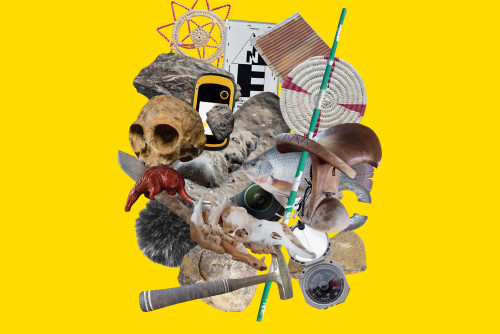
Designing a Discovery
Pictured above: Anjali Biju ’26 (Graphic Design MFA) on site at the Turkana Basin, Kenya.
Dense pockets of pale green grass and shrubbery peeked out from the rocks and dusty Earth. Everywhere Anjali Biju ’26 (Graphic Design MFA) looked, she saw shades of brown in the Turkana Basin, the Kenyan land known for unveiling secrets about mankind. She climbed hills and scrambled over rocks with geologists looking for what might be hidden on the surface.
On this expedition, Biju watched and recorded what she saw. Something on the ground caught her eye.
“I had started reading the landscape differently,” recalled Biju. “Walking with scientists teaches you to see things you’d otherwise miss. What looks like rubble and gravel starts to take on meaning.”
She bent down and held the item aloft. The shouts started immediately.
“Hominin! Hominin!”
Biju knew exactly what she had found — an ancient ancestor’s tooth. The discovery dates back 1.4 million years, a once-in-a-lifetime find.
“There are scientists who have spent their entire careers searching this landscape for exactly this kind of find. What would they think? But everyone — all the geology field school students — gathered around. They were thrilled.”
Faculty Thomas Gardner, program director of the Master of Arts in Social Design, watched the excitement unfold and understood how one tooth can reshape knowledge.
“What a discovery like this sets in motion is remarkable... We’re talking potentially billions of dollars in follow-on research… the cascade of events from a single find is significant,” recalled Gardner.
“I’m trying not to let it become just a story I tell. It happened. And what it opened up mattered more to me than the act itself,” reflected Biju.
A Unique Partnership in the Field
This shift developed while working with Marine Frouin, an assistant professor of geosciences at Stony Brook University, who leads research expeditions at the Turkana Basin Institute (TBI).
“I look at stratigraphy, at the relation to time, and how the [Turkana] basin has evolved, and how the people have adapted,” said Frouin. “I always thought that there is a gap between the science that I do in the field and the way we communicate about our research to the local community.
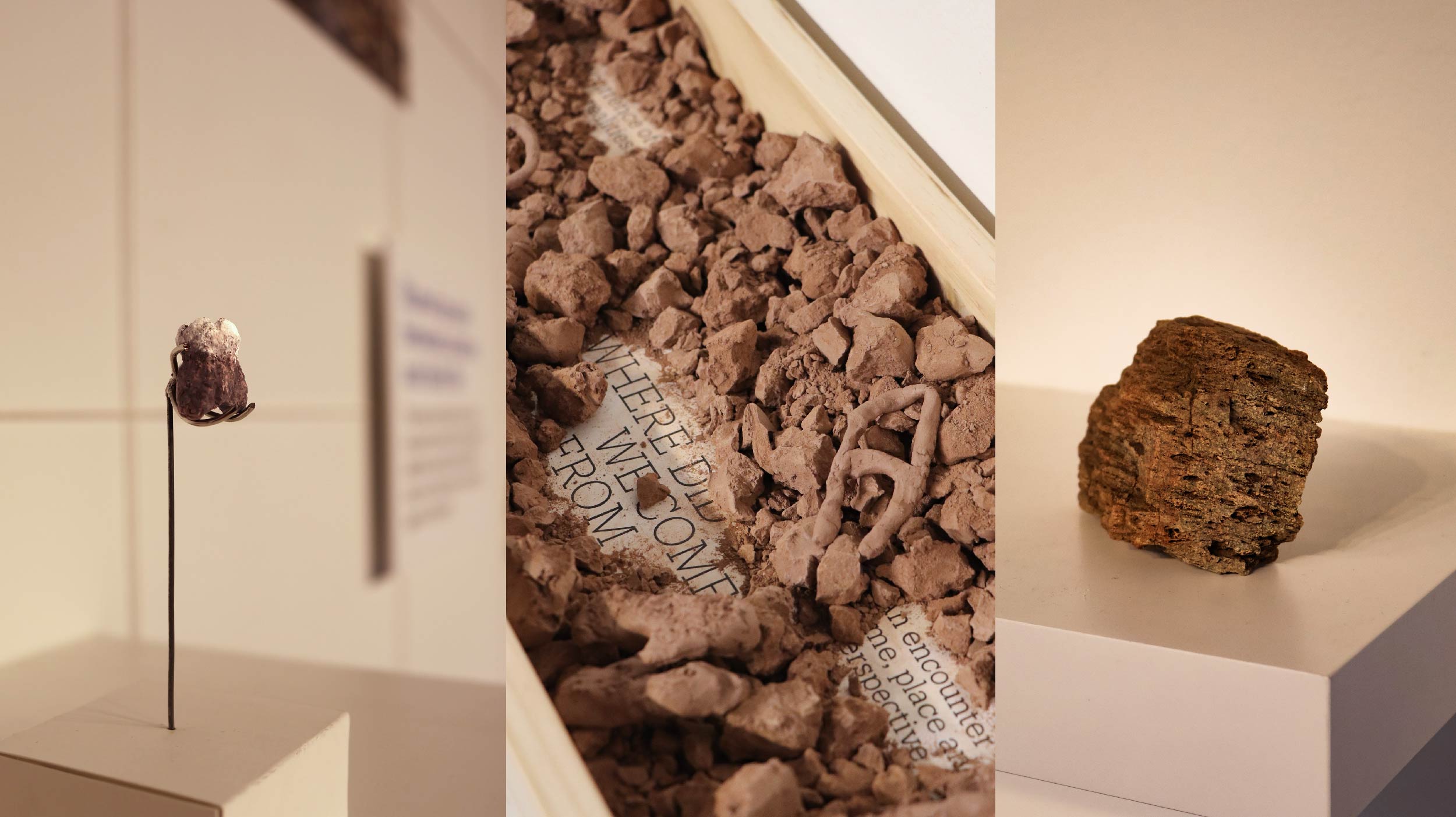
Exhibition details from “Turkana: A Visual Excavation,” including the Hominin tooth (at left).
Design details from “Turkana: A Visual Excavation.”
“When you think back in the day, Darwin and the big scientists were scientists and artists at the same time. We lost this connection between art and science.”
With that in mind, Desmond DeLanty, Frouin’s husband, an architect, and principal of the design-build firm EcoDepot, reached out to his former colleague and friend, MICA’s Gardner.
After visiting TBI in 2024, Gardner contacted Jennifer Cole Phillips, director of the MFA in Graphic Design, for recommendations of students who might want to work at TBI. Phillips recommended Biju.
“In some ways, Anjali was the first one out of the gate — bravely pioneering a path,” Gardner recalled.
What emerged is FIELDwork — an acronym for Foundation for International Experiential Learning and Design Work. The premise is to embed creatives alongside scientific researchers, giving both sides something they could not produce alone.
“This has the potential to really transform the way both science is practiced and disseminated, as well as the opportunities for young creative professionals coming up through art and design schools like MICA,” said DeLanty.
Planning for the Future
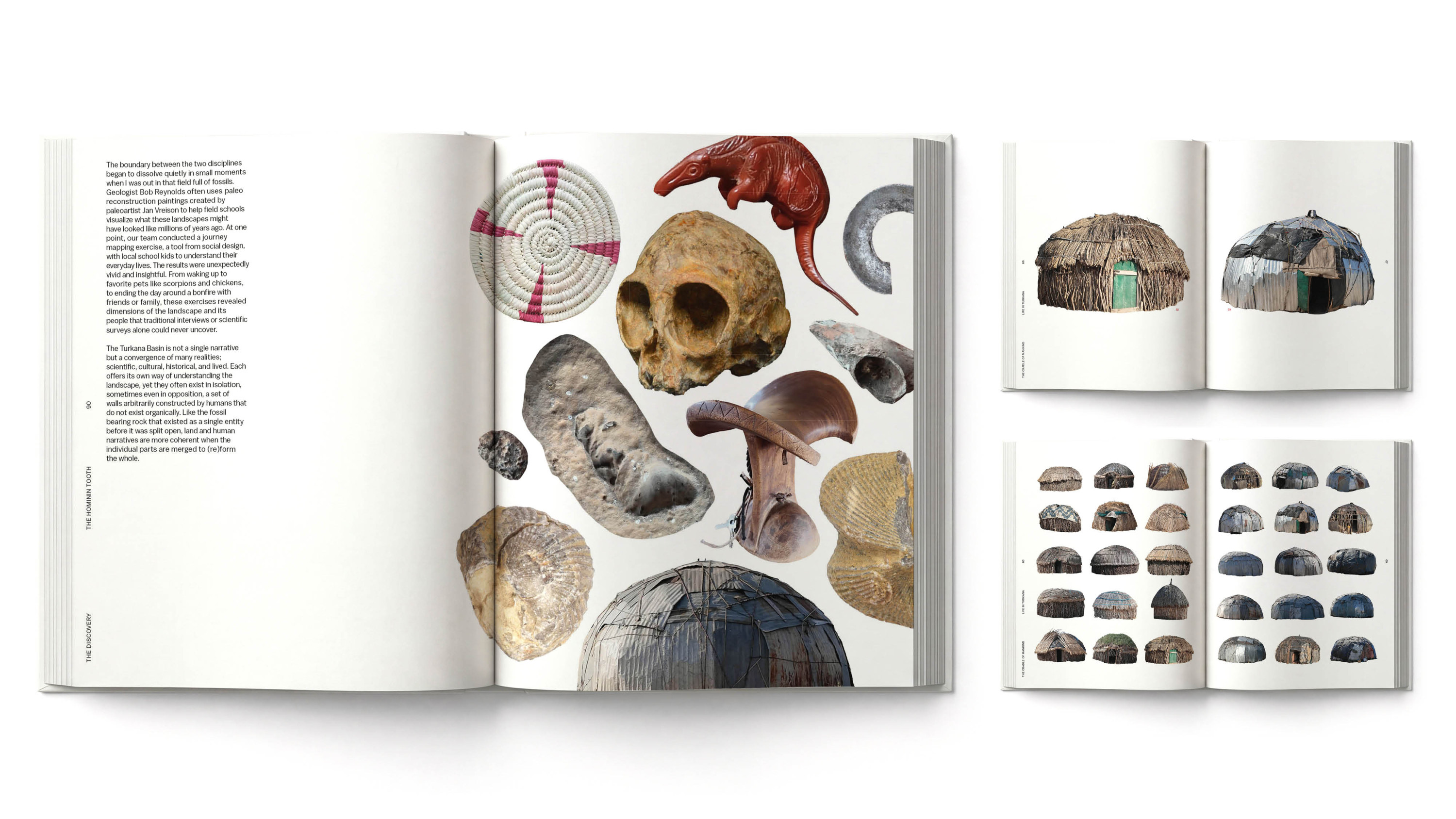
The partnership has led to an exhibition and panel discussion at MICA, a short film, a poster presentation at TBI’s 20th anniversary conference in New York, and Biju’s final thesis project.
“What I was asking was: What does it mean to represent this landscape as someone who’s been there as a designer — someone with fresh eyes? I put my experience into a framework that is accessible, so that people could walk away with something close to the feeling of being there,” said Biju.
FIELDwork returned Biju to TBI this summer and sent her on another expedition in Botswana. Other MICA students went to TBI and a mammoth fossil site in Texas.
The collaboration is extending this fall with a sponsored course and plans for more in the years ahead.
“We’ve really started to focus on the different ways we might be able to integrate with MICA to reach more students at any one time, and also engage with different scales of work,” explained DeLanty.
For Biju, time in the field reshaped her future and possibly that of generations to come.
“This experience changed not only how I see my profession, but also how I see myself within it — it broke stereotypes I had internalized about what graphic design is and can be. Bringing in storytelling, research, and inquiry makes the work more compelling. That shift is going to stay with me.”
Reimagining an Iconic Brand
Pictured above: OLD BAY® commemorative tins, in collaboration with MICA’s Graphic Design department, on display during ArtWalk 2026.
When McCormick & Company began planning the return of OLD BAY® to its iconic metal tin, the company turned to an unexpected source of inspiration just a few miles away: students at MICA.
The collaboration became more than a packaging redesign. It evolved into an educational partnership that challenged students to work within the constraints of one of America’s most recognizable consumer brands while telling a distinctly Baltimore story.
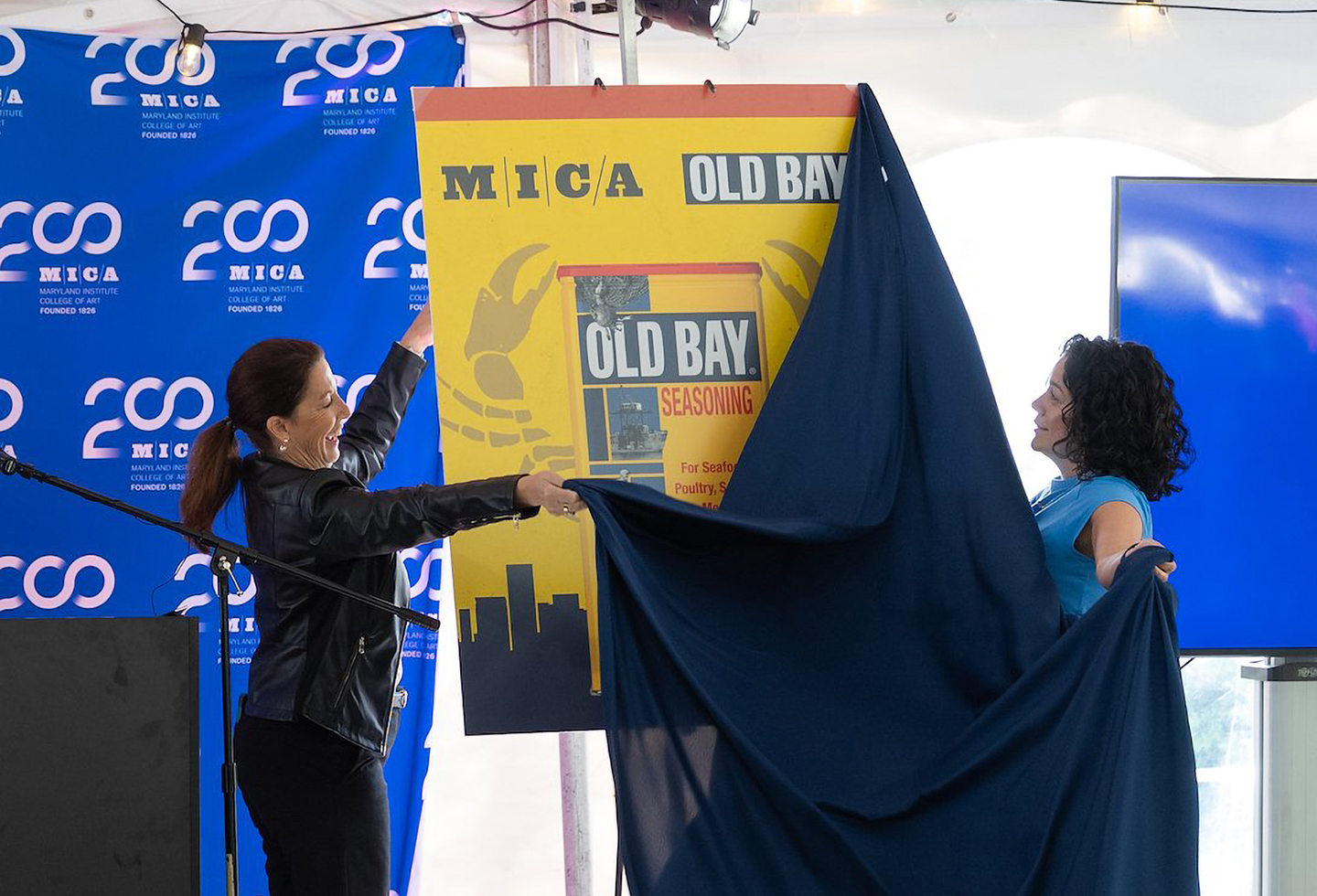
The limited edition OLD BAY® tin packaging, “Hands of the Harbor,” designed by Priscilla Cruz ’26 (Graphic Design BFA).
The result was a limited-edition OLD BAY® tin celebrating the city’s people, history, and creative spirit, along with an experience that allowed students to research, pitch ideas, navigate manufacturing requirements, and see one concept reach store shelves.
More Than a Classroom Assignment
The project began with a question: What makes Baltimore unmistakably Baltimore?
McCormick, whose OLD BAY® seasoning has become synonymous with Maryland culture, wanted to commemorate the brand’s return to traditional metal packaging while celebrating the Chesapeake region. Through MICA’s Graphic Design department, the company developed a partnership involving two courses and more than two dozen students.
Graphic Design Chair Kristian Bjørnard (’09 Graphic Design MFA) coordinated the collaboration, while faculty members Mikea Hugley and Hayelin Choi (’17 Post-Bacc, ’19 Graphic Design MFA) integrated it into their courses.
Students visited McCormick headquarters, met with the design team, presented concepts, received critiques, and revised their work.
“It wasn’t simply, ‘Here’s a class assignment,’” Hugley said. “[The McCormick representatives] treated our students like professional designers.”
Designing Within Constraints
OLD BAY® packaging is instantly recognizable, and decades of brand equity meant certain elements could not change. Students had to respect production specifications, typography, color limitations, manufacturing processes, and loyal consumers while creating something fresh.
“We told them, ‘You can do whatever you want creatively, but if you ignore the required elements or change things the client specifically asked you not to change, you’re reducing the likelihood that your design will be selected,’” Bjørnard said.
A visit to the Pennsylvania facility where the cans are manufactured helped students understand why those requirements mattered.
“Suddenly those technical requirements weren’t arbitrary anymore,” Bjørnard said. “That was a real lightbulb moment.”
Discovering Baltimore Through Design
Students immersed themselves in Baltimore’s history before designing.
“Students had to research Baltimore’s history, McCormick’s relationship to Baltimore, and the story behind OLD BAY®,” Hugley said. “They had to do deep research before they ever started designing.”
Concepts drew inspiration from Baltimore’s pop-art aesthetic, Chesapeake Bay wildlife, signage, history, and architecture.
Graphic design graduate Bryson Wyatt ’26 created “A Walk Around the Bay,” pairing iconic destinations with Chesapeake favorites. His design advanced to the three finalists presented to McCormick.
“It was one of my first experiences designing for something people have an emotional connection to,” Wyatt said. “Learning how to handle that, and then being recognized as a finalist, was a really meaningful way to begin my career.”
A Winning Concept
Graphic Design graduate Priscilla Cruz ’26 developed the winning concept, “Hands of the Harbor.”
Rather than emphasizing seafood or landmarks alone, Cruz focused on the people whose labor helped build Maryland’s identity. Her research explored Baltimore’s industrial history, the Chesapeake Bay’s working waterfront, and traditions surrounding crabbing and seafood production.
The McCormick collaboration, including the grand reveal of Cruz’s design, was publicly announced during the opening remarks of ArtWalk 2026.
“I wanted the design to pay tribute to working-class people and to the traditions that are still deeply connected to OLD BAY®, Maryland, and life along the Chesapeake Bay,” Cruz said.
Using OLD BAY®’s distinctive geometric layout, Cruz created a photographic collage featuring workers, neighborhoods, landmarks, and scenes reflecting Baltimore’s identity.
“I wanted someone walking down the grocery aisle to immediately recognize it as OLD BAY®,” Cruz said. “Then, when they picked it up, they’d realize something was different.”
After her design was selected, several photographs had to be replaced because they couldn’t be licensed commercially.
A Bridge to Professional Practice
For Hugley, experiences like this redefine graphic design education.
“Our students deserve more than hypothetical assignments like designing a logo for an imaginary company,” she said. “Whenever possible, we should partner with real organizations and bring those experiences directly into the classroom.”
Cruz and Wyatt now highlight the OLD BAY® collaboration as they begin their careers, evidence that they can work with real clients, navigate creative constraints, and contribute to nationally recognized brands.
“I’m most proud of the concept,” Cruz said. “Knowing that consumers connected with the design means a lot to me.”
The limited-edition tin celebrates more than a beloved seasoning. It tells a story about place, community, craftsmanship, and collaboration, showing how thoughtful design can honor tradition while introducing new voices into an iconic brand.
Taking to the Field
Pictured above: Fiber faculty Hope Simpara, at left, and student Angel Forsyth, during a fitting for the Baltimore Orioles’ Mama Bird mascot.
On Mother’s Day 2026 at Camden Yards, thousands of Baltimore Orioles fans watched Mama Bird step onto the field in a brand-new outfit.
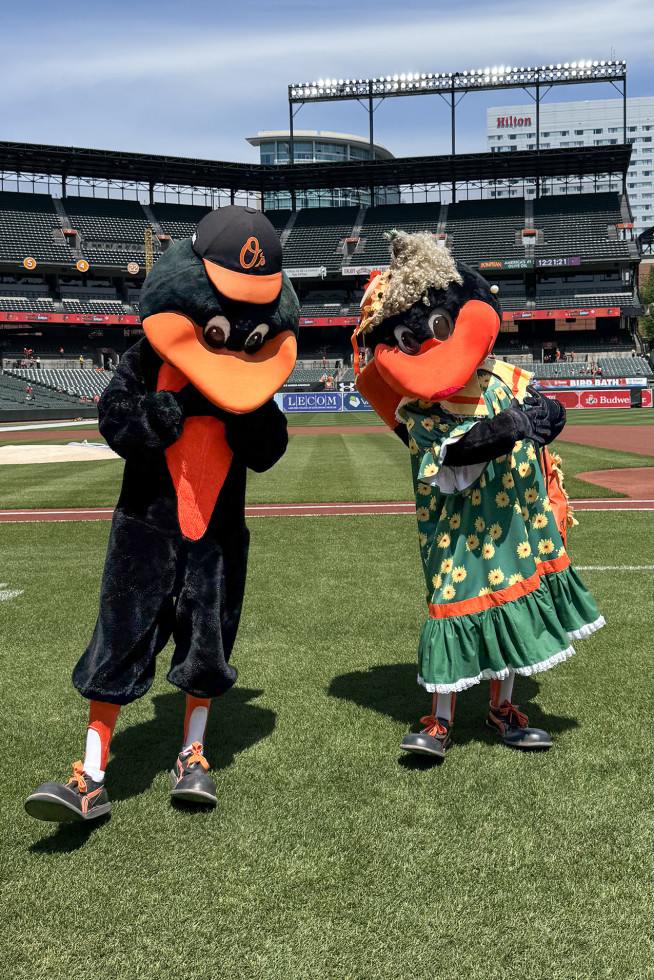
Mama Bird, the Orioles Bird mascot’s mother, appeared in a vintage-inspired floral dress, with a flower-covered hat and coordinated handbag embroidered with the Orioles logo. The look felt nostalgic yet fresh, as though it had always belonged.
What most fans didn’t realize was that the costume had begun only weeks earlier inside a classroom at Maryland Institute College of Art, where students were challenged to reinterpret an iconic community character, honor one of Baltimore’s most recognizable brands, and connect generations of fans.
An Opportunity Born Through Connection
Gabriel Ramos ’25 (Graphic Design BFA), a graphic design associate with the Baltimore Orioles, often spoke about MICA with coworkers. When Orioles Director of Fan Engagement Nick Jones wondered whether someone might help redesign Mama Bird’s aging costume, Ramos thought of his alma mater.
“I told him about the Fiber department and explained that there’s a pretty strong fashion community at MICA,” said Ramos.
Faculty member Hope Simpara received the call and recognized the educational possibilities.
“We met with the mascot coordinator and the events coordinator, and I thought this would be a great fit for my Garment Design and Production course,” she said.
Students would research the Orioles, Maryland culture, mascot history, costume design, textiles, branding, and functionality before pitching concepts to the team.
“My hope was that they would learn the design process and how to pitch to and relate with clients on commissioned-based projects,” Simpara said.
Mama Bird (right), along with the Oriole Bird, on the field of Camden Yard on May 10, 2026.
Beyond Fashion
For Simpara, the assignment blended fashion, illustration, branding, sports, storytelling, and community identity.
“Working across disciplines is the only way to be successful in today’s economy,” she said.
Students explored vintage Orioles logos and uniforms, Maryland history, and state symbols, grounding their designs in the team and region.
A Difficult Decision
The Orioles reviewed sketches, historical research, mood boards, and branding concepts before selecting Angel Forsyth’s proposal.
“We were shown so many beautiful drawings and mockups,” Jones said. “It was truly a difficult decision to choose just one design. There is so much talent at MICA.”
An Illustrator Designs Fashion
Forsyth, then a sophomore GFA major and Illustration minor, had enrolled to learn garment construction. Her illustrator’s approach became an advantage.“I was still using a lot of my character design principles,” Forsyth said. “But I had to start thinking about how the design would function in real life.”
One image kept appearing in her research: Black-eyed Susans. Maryland’s state flower carried personal memories.
“They remind me of growing up, especially picking wildflowers with my dad to bring home to my mom,” Forsyth said. “I wanted to include symbols that would mean something to Orioles fans while also representing childhood, family, and nostalgia.”
Her design combined vintage silhouettes, floral patterns, puffed sleeves, and a palette drawn from historic Orioles branding.
“I’ve always loved older styles because they’re colorful, quirky, and a little campy,” Forsyth said. “I wanted it to feel nostalgic and a little old-fashioned, but still approachable.”
Collaboration Makes the Work Better
With Mother’s Day approaching, the costume became a collaborative achievement. Simpara constructed the garment. An Interdisciplinary Sculpture student created hand-felted Black-eyed Susans for the purse and hat. Fiber artist and adjunct faculty member Hellen Ascoli helped hand-sew accessories and secure the hat to the mascot head.
Baltimore Without Silos
For Ramos, the project showed how Baltimore’s creative and sports communities can strengthen one another.
“It shouldn’t feel like the arts exist in one part of the city and sports exist somewhere else,” Ramos said. “Building those connections strengthens the community as a whole.”
Watching a MICA student’s design appear at Camden Yards reinforced that belief.
“It represented a connection between the city and students who are living and creating in Baltimore,” he said.
Creativity Takes to the Field
When Mama Bird stepped onto the field wearing Forsyth’s design, the applause celebrated more than a new costume. It celebrated an alumnus who remembered his school, a faculty member who created experiential learning, and a student who ventured outside her discipline.
“I think this experiential learning assignment showed students that opportunities can come from everywhere,” Simpara said. “They do possess the skills and resources to do professional work, even as students.”
For Forsyth, success was watching people connect with the story embedded in the design.
“If the design resonates with people before I ever have to explain it,” Forsyth said, “then I feel like I’ve succeeded.”
That sentiment captures the heart of MICA’s creative impact: It crosses boundaries, builds relationships, and creates connections that make the work and the city stronger.
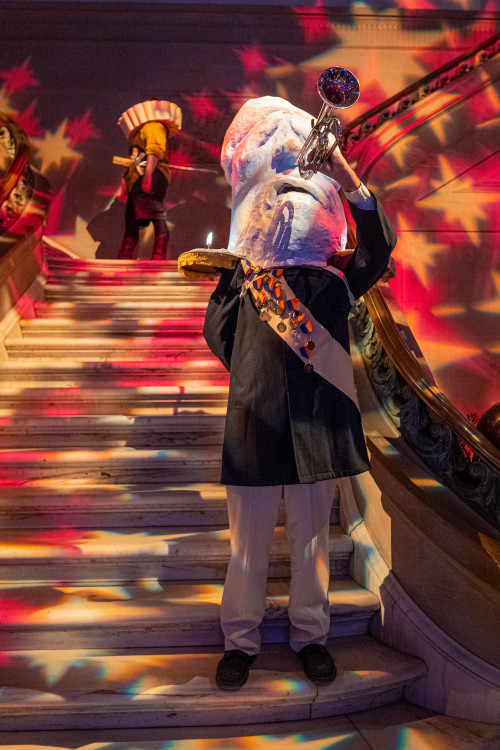
At the Fête of Lights: Bicentennial Gala, Aidan Leizerov ’28 (Interdisciplinary Sculpture BFA) wore their wax soldier costume created in the Mask and Headdress course taught by Valeska Populoh, faculty in the Fiber, Fashion, and Textile program. On the upper landing, Martin Knuppel ’26 (Illustration and Printmaking BFA) is dressed as a modern version of the First Lord of Baltimore. Leizerov and Knuppel were part of a larger student interpretation of the Main Building’s Maryland painting. Students created a living mural that was more representative of MICA's students today.
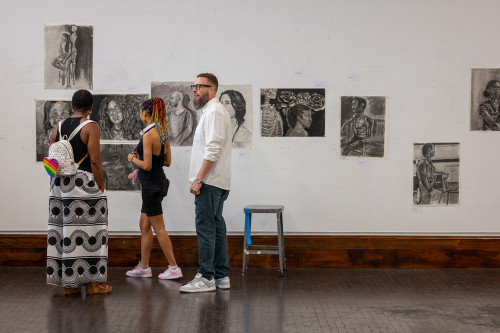
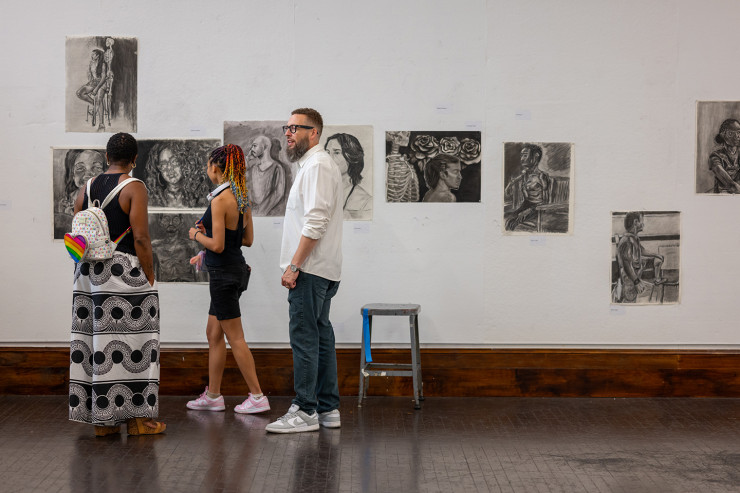
Visitors explore students’ work during the final exhibition of MICA’s 2026 Pre-College Summer Intensive. Featuring work across painting, photography, sculpture, animation, illustration, and game design, the final exhibition brings together students, families, and art lovers to celebrate the next generation of creatives.