
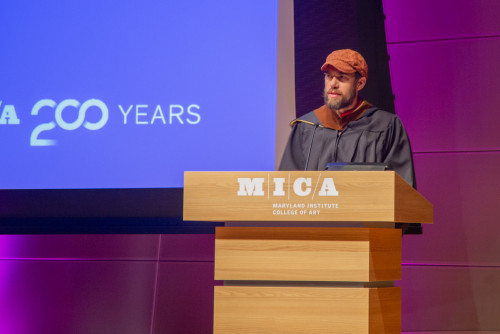
On behalf of the faculty, welcome to campus.
Most of you are here because you want to make things. Somewhere along the way, people get told that being good at making art means being able to draw a lifelike tiger. A tiger with realistic fur. A tiger that makes people say, "Wow, that is definitely a tiger."
Sure, tigers are great. But my hope is that it is not what any of you came here to make.
You came here to learn how to make meaning. To make sense. To practice noticing things others miss. To decide when one choice is better than another — and then, explain why. You came here to develop a point of view, and the nerve to uphold it while other people ask questions.
In your previous classrooms, someone may have claimed to have the answers already. The assignment had a solution. The teacher had the thing they wanted you to say.
Instead, your MICA professor might look at your work and, rather than tell you “it’s good,” ask you 20 questions. What does a shape mean? Why did you choose a specific pattern? They hope the Socratic method jogs something in you, sending you on an answer-finding mission.
Or the faculty may respond with facts: You did make this very yellow. That is much larger.
This can be annoying. Faculty don't merely hand you information, answers, and technical proficiency. We aim to help you see, to build your own judgment about what something is, what it means, how it is made, who it is for, and what it does out in the world.
That means your work will go up in front of people. Drawings, prototypes, paintings, films, photos, interfaces, objects, poems, essays, performances, experiments that seemed like a good idea at 3:00 in the morning — all of it.
A room full of people will look. They will tell you what they see. They will tell you what they think is and isn’t working. They will tell you what they think your work means.
Sometimes they will be right. Sometimes they will be wildly, impressively wrong. Although, if your professor has you reading Barthes or Berger, you will find out they might actually still be right.
You have to decide what to do with that. Sometimes that means you just say, “Thanks for the data; I choose to do nothing.” Sometimes a single new thread from a peer unlocks the next great trajectory of your work.
A form maker — a form giver — has to learn about more than form. You have to learn about nature, and tools, and technology, and history, and psychology, and bodies, and language, and power, and jokes, and grief, and attention spans, and why one blue feels expensive while another blue feels like a dentist's office.
How do we make meaning with care, intelligence, skill, and courage? Your faculty are here for that project. We are still making things too. We have studios, practices, drafts, doubts, obsessions, failures, weird research interests, and strong opinions about typefaces, archives, biochar, cameras, code, color, glazes, pixels, paper, and how you know when something is actually done. Hint: It often never is!
Get to know us. Come to office hours even if there is not a crisis! Bring a question unrelated to your class. Bring an unfinished thing that you’re just working on. These relationships are the whole point. Faculty pay attention. They are people who will push you.
There is room here for the awkward, the “ugly,” the negative, the uncertain, the too-much, the not-yet. You don't need “beautiful.” You don't need finished. You need practice.
So, make things. Make the drawing. Make the object. Make the poster. Make the film. Make the app. Make the poem. Make the essay. Make the mess. Make the thing you do not yet know how to make.
Then look at it. Talk about it. Ask what it is doing. What it means. Who it is speaking to. What it knows that you didn’t before you made it.
Over time, this is how you cultivate taste. Not taste as in highbrow liking-of-fancy-things. Taste as in judgment. Discernment. The ability to say: this matters to me, this is good or at least this is almost there. This work feels alive.
Welcome to the studios. Welcome to MICA.