
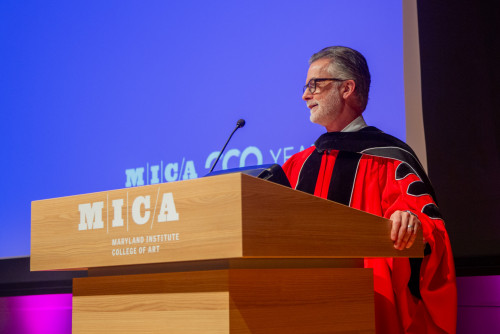
Good morning, and welcome to the new academic year at MICA. It is wonderful to have all of you here.
Over the last few days, I had the chance to talk with several parents and families during and after Move-In Day, and I asked: How did it go?
By most accounts, the move-in went pretty well. People found their buildings. Things got where they needed to go. Our staff and volunteers did a great job.
The more interesting stories began when I asked about the unpacking. That moment when you realize that something essential is still sitting at home, while something no one particularly needs somehow made the trip.
And then comes the inevitable question: Who was responsible? How did that get in there? And where is my hair dryer? My favorite shirt? My new sketchbook?
Based on my conversations, there was not always complete agreement about who was responsible. Apparently, this also accounted for a fair number of trips to Target.
All of this got me thinking about packing and, more specifically, about the idea of parsimony.
Parsimony? Parsimony is an interesting word because it can carry a negative meaning. We sometimes associate it with stinginess, excessive frugality, or simply not providing enough.
That is not the version of parsimony I have in mind.
In its more useful sense, parsimony is about economy in how we approach discernment. It is using what is necessary and being thoughtful about what we add.
In science, this idea is often associated with Occam’s razor and what is sometimes called the law of parsimony. It is not a framework for simply choosing one theory over another because it is simpler. Rather, it is an abductive strategy. When several explanations are possible, we should avoid adding assumptions that are not necessary to account for the evidence.
In other words, parsimony is about being deliberate about the complexity we introduce; it is not about reducing an idea to its simplest possible form.
When several explanations fit the evidence, we should be cautious about adding assumptions simply because we can. That does not mean the world is simple. It means that added complexity should have a reason for being there.
Human experience, culture, history, and identity are often irreducibly complicated. We should not simplify them merely to make them easier to explain. A strong parsimonious interpretation requires judgment about what the evidence allows us to say and humility about what it does not.
Artists and designers know this tension particularly well.
Every creative act involves choices about what to include, what to emphasize, what to remove, and what deserves space.
Sometimes restraint is the answer. Sometimes abundance is exactly what the work requires.
The point is not simply to have less. The question is: what approach is best aligned with the task at hand?
It is to know why something is there.
You arrived at MICA carrying far more than what was in the car on Move-In Day.
You brought experiences, expectations, habits, and ideas about yourself and the world. Some of those things have been carefully chosen. Others may have found their way into the bag without much thought at all.
A college education gives you the opportunity to pack and unpack. At MICA, that process is a requisite part of your education, whether you are in a studio, a humanities class, a critique, or somewhere beyond the classroom.
As you engage with the MICA community, you may encounter evidence that challenges something you believe. A classmate may see something different because of an experience you have never had. A faculty member may introduce you to a way of working you have never considered.
You may discover that something you were certain belonged in your vision of the future no longer does after taking a class, having an internship, or after creating a prototype or work of art.
Or you may unpack something you brought with you and understand for the first time just how important it is.
These are illustrative of the reasons why I do not think the goal of education is simply to accumulate more.
When education is at its best, it helps us become more discerning about what deserves our attention and what we choose to carry forward. It also changes how we understand and express what we know through our writing, our conversations, our research, our art, and our design.
At an art and design college, we might think of this as reframing.
A frame does not necessarily change the thing itself, but it can change how we see it. Put an idea in a new context, place it beside something unexpected, or encounter it through someone else’s experience, and its meaning can shift.
What was in the background comes forward. Something that seemed central becomes less important. You notice something you had overlooked. You might be conveying something through purposeful omission.
Over the next year, I hope the experience of reframing happens to you often.
Critique is one intentional way that happens here, but certainly not the only one. It may happen in a classroom, in a studio, during an internship, or in a conversation with a roommate.
And as you decide what stays and what goes, remember that not everything heavy is baggage.
Our histories, relationships, communities, values, and experiences can provide the grounding that allows us to venture somewhere new. They can give us confidence and strength when something unfamiliar unsettles us or when we encounter an unexpected challenge, when you need support, and your experience requires resilience.
Part of the work is learning the difference between the foundational parts of who we are and what has become unnecessary baggage.
So perhaps the lesson from Move-In Day is not that you should have packed more or packed less.
It is that we rarely know how well we have packed until we begin the process of unpacking.
Someone may have helped you pack the first bag. Someone may have done a lot of it for you. Someone may even have taken the blame for whatever was left at home.
But from here, the choices increasingly belong to you: What deserves space? What needs another look? What can be left behind? And what have you not yet encountered that you will want to make room for?
When the time comes to pack again, I hope you leave MICA not carrying more. What I hope for you is that you understand better what is worth carrying!
That is the parsimony of packing.
Welcome to MICA.