
The current work of the Center for Creative Impact falls within four thematic initiatives:
- urban ecosystems: Imagining livable and sustainable urban ecosystems
- sustainable food systems: Designing sustainable, equitable, and resilient food systems
- road safety & equity: Designing community-centered interventions to increase safety for all road users
- public health: Addressing critical problems in healthcare, medicine, and public health through design
Urban Ecosystems: The Shed
Leveraging the creative power of art and design to imagine livable and sustainable urban ecosystems
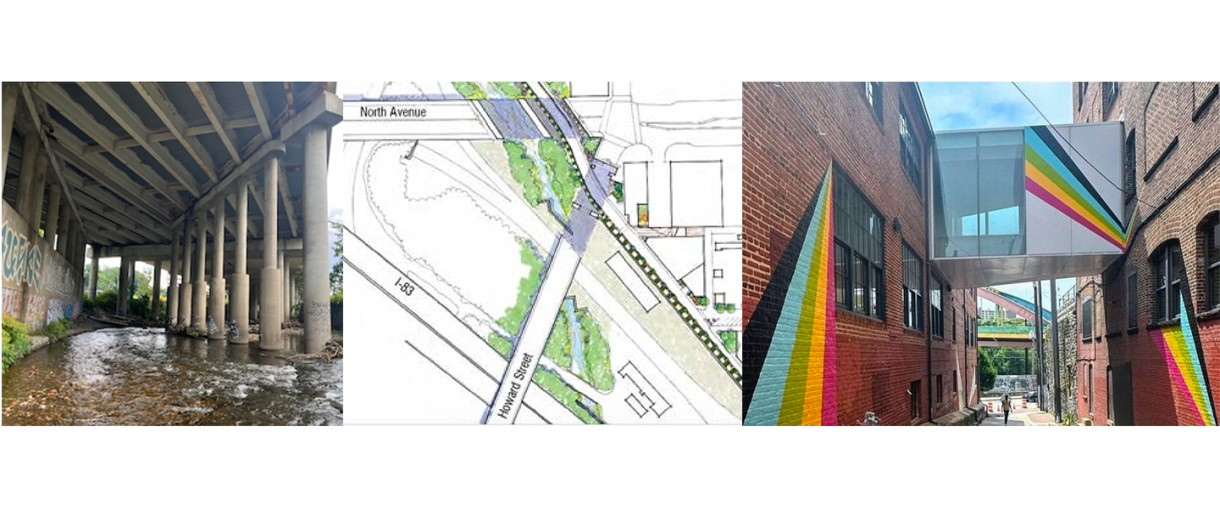
Left: A large segment of the Jones Falls river was buried in 1915 under what is now the I-83 expressway. Center: MICA is reimagining three sites along Falls Road and North Avenue as a part of the broader Jones Falls Gateway Masterplan. Right: MICA collaborated with Midtown Baltimore and MICA alum Jaz Erenberg to install the “Color Rays” mural in Trenton St Alley.
Overview
The Jones Falls Watershed is a vast network of waterways, a diverse ecosystem encompassing more than 40-square miles, connecting hundreds of rural, suburban, and urban communities across Baltimore City and County. The lack of a public sewage treatment system led Baltimore to bury much of the river in 1915 and to build an elevated highway over it in the mid-1950s. Today, the Jones Falls is an under recognized ecological and economic asset, largely neglected and polluted, a victim of failed urban planning, inadequate investment, and a lack of vision and public support.
The histories of the Jones Falls and MICA have been intertwined for centuries and the river winds through the center of MICA’s campus. The Shed is a multi-year initiative in collaboration with community partners to increase awareness of, inspiration for, and investment in the Jones Falls, by leveraging MICA’s creative talent for: Co-creating inspirational and sustainable future visions and plans for the watershed; Demonstrating creative installations, spaces, and solutions on our properties adjacent to the Jones Falls to catalyze and inspire wider investment in the watershed.
Projects
- Jones Falls 2076: Engaging MICA’s and Baltimore’s broader creative community in imagining aspirational, alternative future visions for the Jones Falls River, 50 years from now, through a series of speculative workshops, public exhibitions, and a publication.
- Jones Falls Watershed Strategic Planning: Leveraging MICA’s creative talent to help advance the city-wide effort led by the Friends of the Jones Falls to co-create a shared vision and plan for the Jones Falls Watershed.
- Falls Road: equity + safety project: Designing creative interventions to increase safety and accessibility for all road users along the historic and scenic Falls Road greenway.
- Jones Falls Gateway: Transforming three neglected MICA properties to help advance the broader Jones Falls Gateway Masterplan:
- MICA Park: redesigning our small parcel between the North Ave and Howard St bridges into a vibrant openair greenspace, classroom, and event space celebrating art and ecology;
- gallery alley: transforming the MICA-owned segment of W. Trenton Alley into an open-air gallery celebrating art and ecology with installations by alumni, faculty, and students;
- North Ave Gateway: redesigning our empty lot and retaining wall along North Ave into an open-air amphitheatre and gateway for pedestrians and bicyclists to Falls Road.
Sustainable Food Systems
Advancing creative and interdisciplinary solutions to reduce wasted food

Left: Our goal is to fundamentally redesign the food system to be circular in which resources are used, reused, and recovered, and waste is minimized Center: MICA is collaborating with leading researchers and practitioners to publish and share the impacts of our work to reduce wasted food. Right: MICA is co-facilitating a pioneering project to engage frontline workers in generating and testing ideas for reducing supermarket food waste.
Overview
Food loss and waste represent a significant economic, social, and ecological challenge in the US. Approximately 40% of the 235 million tons of food produced by the US food system each year is unsold or uneaten. Our wasteful food system results in significant pollution and loss of natural resources — land, water, energy, nutrients — needed to produce that food, billions of dollars lost in economic value, and increased stress on the 47 million Americans (nearly 14% of the population) living in food-insecure households.
MICA’s Center for Creative Impact is a key partner in Multiscale RECIPES for Sustainable Food Systems, a five-year, $15-million initiative supported by the National Science Foundation (NSF) to create new and innovative knowledge and solutions to transform our wasteful food system. MICA is the design lead for RECIPES, a national network bringing together over 40 researchers and 14 institutions working across the food system to advance the science needed to address the systemic challenges of food waste.
Projects
- Convergence Café is a series of creative activities facilitated by MICA to encourage collaboration, sharing, and learning among leading food waste researchers and practitioners across the US, to spark innovative, interdisciplinary solutions to wasted food problems.
- Fresh Rescue Champions is a unique collaboration between designers at MICA, anthropology and public health researchers at Johns Hopkins, and frontline supermarket workers at Albertsons, the second largest US grocery retailer, to generate and test creative ideas for reducing wasted food by increasing donations of healthy, safe, and edible food items.
Road Equity & Safety
Designing community-centered interventions to increase safety for all road users
Overview
In Baltimore City there is one crash every 30 minutes, one traffic-related injury every hour, and one traffic-related fatality every week. Since 2018, we've been working closely with the Maryland Department of Transportation’s Highway Safety Office to advance "road equity" -- road access and safety for all road users -- in Baltimore City.
Projects
- Falls Road equity & safety: We are currently collaborating with MICA faculty and students, neighborhood partners, and diverse road users along the historic and scenic Falls Road to develop creative interventions to increase safety and access for all road users.